
The Questions That Could Define the Next Era of Longevity Science
The longevity field has entered an unusual phase of development. For decades, aging research focused primarily on understanding why organisms grow old. Today, researchers are increasingly asking whether aging can be measured, modified, and eventually targeted through medicine.
The result has been an explosion of discoveries spanning cellular senescence, epigenetic clocks, immune aging, stem-cell biology, metabolic interventions, artificial intelligence, and regenerative medicine. Yet as the field expands, another challenge has emerged: deciding which questions matter most.
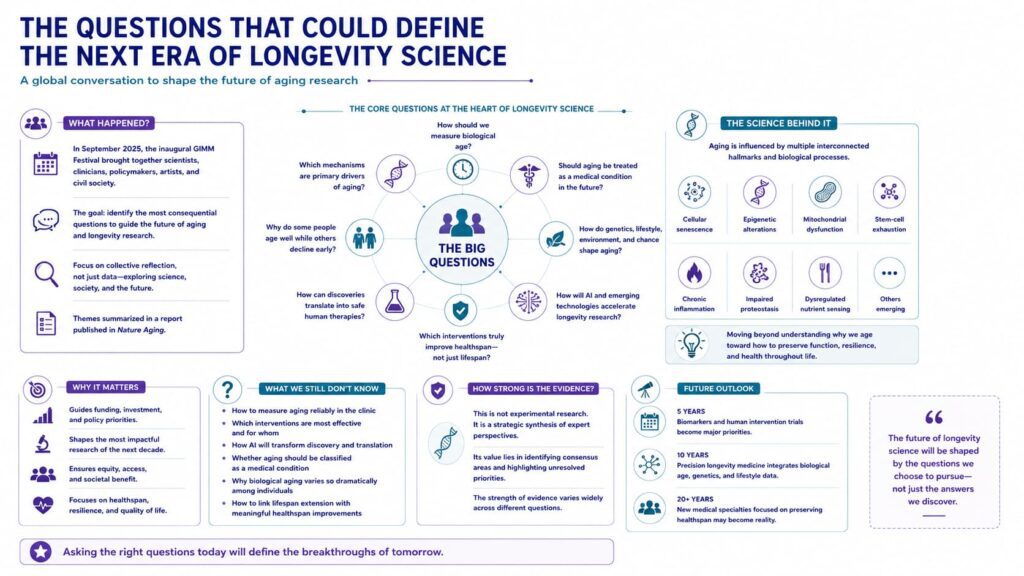
That issue became the focus of the inaugural Aging and Longevity Festival hosted by the Gulbenkian Institute for Molecular Medicine (GIMM) in Lisbon. Bringing together scientists, clinicians, policymakers, artists, and members of civil society, the meeting sought to identify the questions that should shape the future of aging research. The resulting discussion offers a revealing snapshot of where longevity science may be heading next.
What Happened?
Held in September 2025, the inaugural GIMM Festival assembled participants from across disciplines to explore the future of aging and longevity research. Unlike traditional scientific conferences focused on presenting data, the meeting emphasized collective reflection.
Researchers examined not only current discoveries but also the assumptions, priorities, and societal implications guiding the field. The report published in Nature Aging summarizes the themes that emerged from scientific sessions and structured discussions. Rather than generating definitive answers, participants focused on identifying the most consequential unanswered questions.
These questions spanned biology, medicine, technology, ethics, economics, and public policy. The exercise reflects a growing recognition that aging is not simply a biomedical problem. It is also a social, economic, and political challenge.
The Science Behind It
Aging research has historically been organized around a central biological question: Why do organisms age? Over the past two decades, major progress has been made in answering that question. Researchers have identified multiple hallmarks of aging, including:
- Cellular senescence
- Epigenetic alterations
- Mitochondrial dysfunction
- Stem-cell exhaustion
- Chronic inflammation
- Impaired proteostasis
- Dysregulated nutrient sensing
These frameworks have transformed aging from a descriptive phenomenon into a mechanistic scientific discipline. Yet many fundamental questions remain unresolved. One concerns causality.
Which aging hallmarks are primary drivers, and which are downstream consequences? Another concerns measurement. How should researchers define biological age? Can aging be quantified reliably enough to guide clinical decisions?
The field is also wrestling with questions of heterogeneity. Why do some individuals remain healthy into their nineties while others develop age-related disease decades earlier? What role do genetics, lifestyle, environment, and chance play?
Researchers are increasingly interested in resilience rather than decline alone. Instead of focusing exclusively on why aging occurs, scientists are asking why some individuals age exceptionally well.
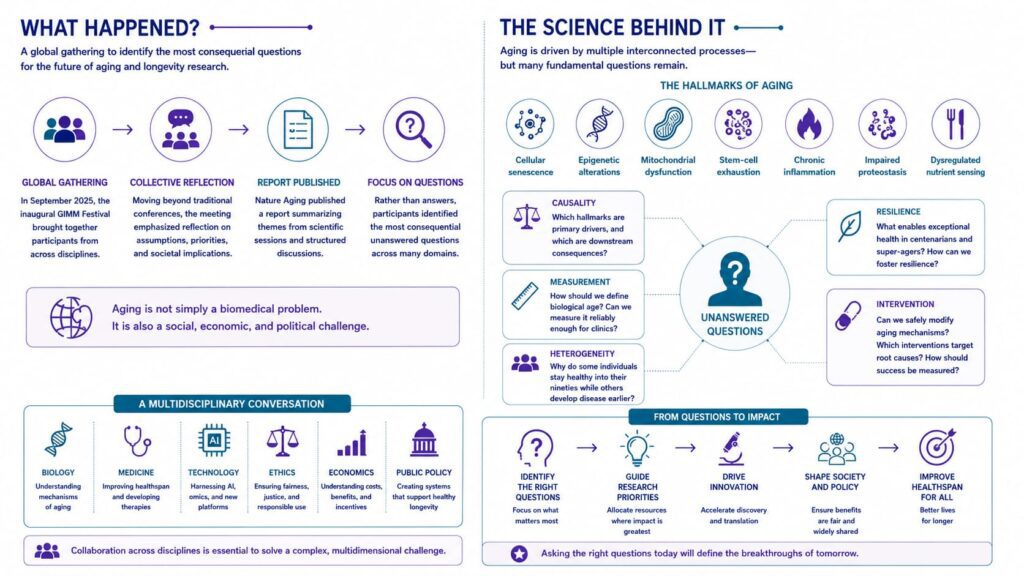
Centenarians, super-agers, and healthy elderly populations may provide important clues. Perhaps the most ambitious questions involve intervention. Can aging mechanisms be modified safely?
Which interventions target root causes rather than symptoms? And how should success be measured?
How Strong Is The Evidence?
This report is not experimental research. It does not provide new biological data or clinical outcomes. Instead, it serves as a strategic synthesis of expert perspectives.
Its value lies in identifying emerging consensus areas and highlighting unresolved scientific priorities. The evidence supporting individual questions varies considerably. Some topics, such as cellular senescence and biological age measurement, are supported by substantial research programs. Others remain largely conceptual.
Why It Matters for Longevity
Scientific progress is often shaped as much by the questions researchers ask as by the answers they find. The longevity field is reaching a stage where strategic prioritization matters. Funding agencies, investors, biotechnology companies, and policymakers increasingly influence which areas receive resources.
The questions highlighted at the GIMM Festival suggest several major themes likely to dominate the coming decade. First is measurement. Reliable biomarkers remain essential for evaluating interventions. Second is translation. How can discoveries in laboratory organisms become practical human therapies? Third is equity. Who benefits from longevity advances, and how can those benefits be distributed fairly? Fourth is systems biology. Aging appears increasingly interconnected across tissues, organs, and molecular pathways. Understanding those interactions may prove more important than studying isolated mechanisms.
Perhaps most importantly, the report signals a shift in perspective. The field is moving beyond simply extending lifespan toward understanding how to preserve function, resilience, and health throughout life.
What We Still Don’t Know
Many of the most important questions remain unanswered. Researchers still lack definitive explanations for why biological aging varies so dramatically among individuals. The relationship between lifespan extension and healthspan improvement also remains uncertain.
Other unresolved issues include:
- How aging should be measured clinically
- Which interventions are most effective
- How AI will influence longevity research
- Whether aging should eventually be treated as a medical condition
The answers to these questions will likely shape the next generation of research.
Future Outlook
Over the next five years, aging biomarkers and human intervention trials will likely become major priorities. Within a decade, precision longevity medicine may begin integrating biological age measurements, genetics, and lifestyle data into personalized strategies.
Twenty years from now, the questions identified today may define entirely new medical specialties focused on preserving healthspan. Whether those ambitions are realized will depend on scientific rigor, clinical validation, and public trust.
Conclusion
The future of longevity science will not be determined solely by new technologies or breakthrough discoveries. It will also be shaped by the questions researchers choose to pursue.
The GIMM Festival highlights an important moment for the field: a transition from understanding aging toward deciding what should come next. In a discipline still defining its future, asking the right questions may be one of the most valuable scientific activities of all.
The GIMM Festival was a multidisciplinary event organized by the Gulbenkian Institute for Molecular Medicine focused on aging and longevity research.
Research priorities influence funding, clinical development, scientific progress, and ultimately the direction of the longevity field.
Key themes included aging biomarkers, intervention development, healthy longevity, resilience, translation to humans, and societal implications of longer lives.
That was the focus of the inaugural GIMM Festival, where researchers, clinicians, policymakers, and other stakeholders gathered to identify the challenges likely to shape the next era of aging research.
The discussion moved beyond specific therapies and explored deeper issues: how to measure aging, how to translate discoveries into medicine, and how society should prepare for longer lives.
Sometimes the future of a field is determined less by the answers it has—and more by the questions it chooses to pursue.
A new report from the GIMM Festival highlights the challenges likely to shape the future of aging research, from biomarkers and interventions to resilience and healthy longevity.