
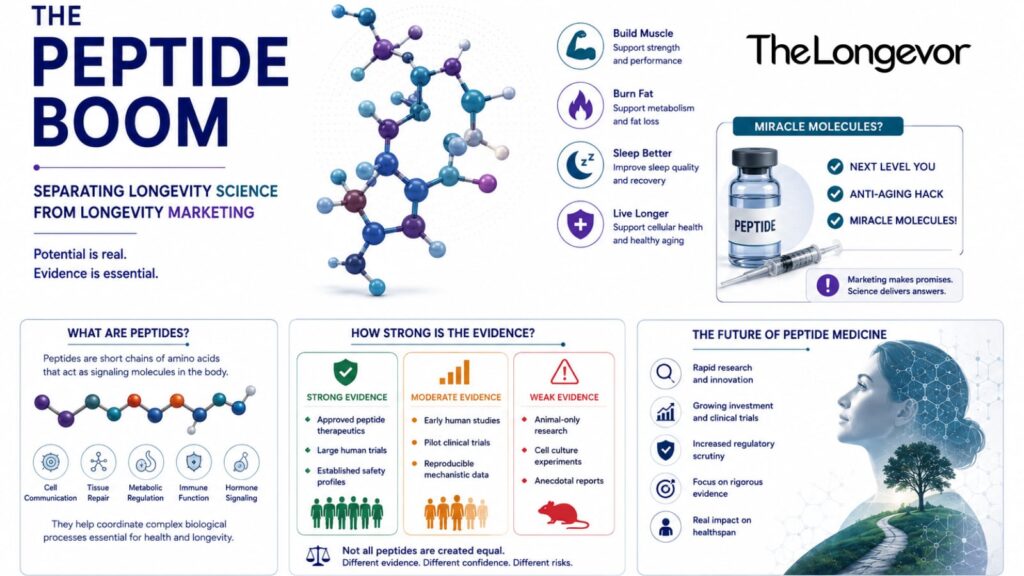
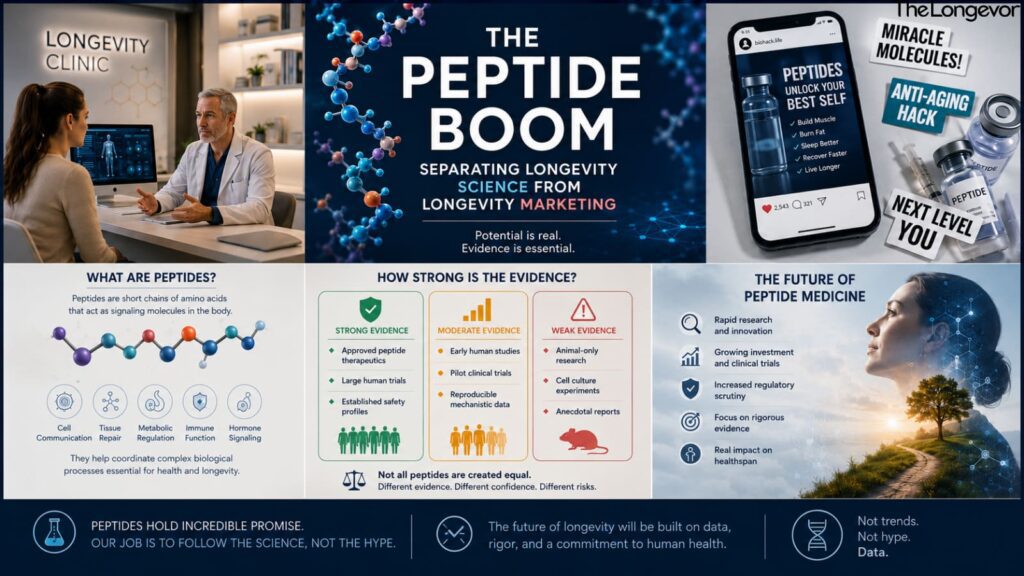
The Peptide Boom: Separating Longevity Science from Longevity Marketing
Walk into a modern longevity clinic, browse online wellness forums, or spend time in biohacking communities, and one topic appears almost everywhere: peptides.
Promoted for everything from muscle growth and injury recovery to fat loss, sleep optimization, cognitive performance, and healthy aging, peptide therapies have become one of the fastest-growing segments of the longevity economy. The enthusiasm is easy to understand.
Peptides are naturally occurring molecules that already play central roles throughout human biology. Many function as signaling molecules, helping cells communicate, repair tissues, regulate metabolism, and coordinate physiological responses. Yet as peptide demand has expanded, so has the gap between scientific evidence and commercial claims.
A recent Nature investigation highlights a growing concern among researchers: public enthusiasm for peptide therapies may be moving faster than the underlying science. For longevity medicine, this creates both an opportunity and a challenge.
What Happened?
Nature’s report examines the rapidly expanding market for peptide therapies and the evidence supporting many of the compounds currently being promoted. Peptides are short chains of amino acids that act as biological messengers throughout the body.
Several peptide-based medicines have become highly successful pharmaceuticals. Perhaps the best-known examples are GLP-1 receptor agonists, which have transformed obesity and diabetes treatment. That success has helped fuel broader interest in peptides as a therapeutic category.
However, researchers interviewed in the report emphasize that many peptides now marketed through wellness clinics and online channels lack the rigorous evidence required for medical validation. Some compounds are supported primarily by:
- Cell culture studies
- Animal experiments
- Small pilot studies
- Anecdotal reports
Others have progressed further into clinical research. The challenge for consumers and clinicians is distinguishing between these very different evidence levels.
The Science Behind It
Peptides occupy a unique position in biology. Unlike traditional small-molecule drugs, peptides often mimic naturally occurring signaling molecules. Many influence pathways relevant to aging and longevity. Researchers are investigating peptide therapies targeting:
- Muscle preservation
- Tissue repair
- Metabolic regulation
- Immune function
- Inflammation
- Wound healing
- Neuroprotection
This biological versatility helps explain the excitement. For example, aging is associated with declines in regenerative capacity, altered cellular communication, chronic inflammation, and impaired metabolic regulation.
Peptides could theoretically influence several of these processes. However, theoretical potential is not the same as clinical evidence. Many popular longevity peptides remain poorly studied in humans. Compounds frequently discussed in biohacking communities include:
- BPC-157
- Thymosin beta-4 derivatives
- Growth hormone secretagogues
- Various experimental regenerative peptides
While some show promising preclinical data, robust randomized controlled trials are often lacking. The distinction matters because biological plausibility does not guarantee clinical efficacy. Longevity history contains numerous examples of interventions that appeared promising in laboratory studies but failed to produce meaningful benefits in humans.
How Strong Is The Evidence?
The evidence landscape varies dramatically by peptide. Some peptide-based drugs have extensive clinical validation and regulatory approval. Others remain experimental. In general, evidence falls into several categories:
Strong Evidence
- Approved peptide therapeutics
- Large human trials
- Established safety profiles
Moderate Evidence
- Early human studies
- Pilot clinical trials
- Reproducible mechanistic data
Weak Evidence
- Animal-only research
- Cell culture experiments
- Anecdotal reports
A major challenge is that public perception often fails to distinguish among these categories. The result is a tendency to place established medicines and experimental compounds into the same conceptual bucket.
Why It Matters for Longevity
The peptide boom reflects a broader shift occurring across longevity science. Increasingly, individuals are seeking interventions that target biological function before disease develops. Peptides fit naturally within that framework because they influence communication networks already embedded within human physiology. For researchers, peptides represent a potentially powerful therapeutic platform. For clinicians, they may eventually expand treatment options across multiple age-related conditions. For investors, they have become one of the fastest-growing sectors in longevity biotechnology. However, premature commercialization creates risks. If unproven compounds are widely promoted before sufficient evidence exists, public trust can erode. The longevity field has already struggled with exaggerated claims surrounding supplements, anti-aging products, and wellness technologies. Maintaining scientific credibility will require careful distinction between promising hypotheses and demonstrated outcomes.
What We Still Don’t Know
Many critical questions remain unanswered. For numerous peptides currently marketed in longevity settings, researchers still lack:
- Large randomized controlled trials
- Long-term safety data
- Optimal dosing strategies
- Comparative effectiveness studies
- Reliable aging-related endpoints
Even when short-term effects appear promising, long-term biological consequences remain uncertain. Future studies must determine not only whether peptides work, but for whom, under what circumstances, and with what risks.
Future Outlook
Over the next five years, peptide research is likely to expand rapidly as investment and commercial interest continue growing. Within a decade, some currently experimental compounds may progress into validated therapeutic categories. At the same time, increased regulatory scrutiny is likely. The future winners will probably be peptides supported by rigorous clinical evidence rather than marketing momentum. For longevity medicine, the challenge will be translating biological promise into demonstrable human benefit.
Conclusion
The excitement surrounding peptides is not entirely misplaced. These molecules represent one of the most biologically sophisticated therapeutic platforms currently being explored in medicine. But enthusiasm should not be mistaken for evidence. Some peptide therapies are supported by robust clinical research. Others remain intriguing scientific hypotheses. For a field committed to extending healthspan through evidence-based interventions, that distinction matters. The future of peptide medicine will ultimately be determined not by social media trends or clinic marketing, but by the same standard that governs all of science: data.
Peptides are short chains of amino acids that act as signaling molecules throughout the body and regulate numerous biological processes.
No. Evidence varies considerably between compounds, ranging from approved medicines to experimental molecules with only preclinical data.
Many peptides influence biological pathways involved in metabolism, tissue repair, inflammation, and cellular communication, making them attractive candidates for healthy-aging interventions.
Peptides may be one of the most promising therapeutic platforms in longevity medicine.They may also be one of the most overhyped.A new Nature analysis explores where the science ends and the marketing begins. The key question isn’t whether peptides work—it’s which ones.