
Can a Blood Test Reveal How Your Brain Is Aging?
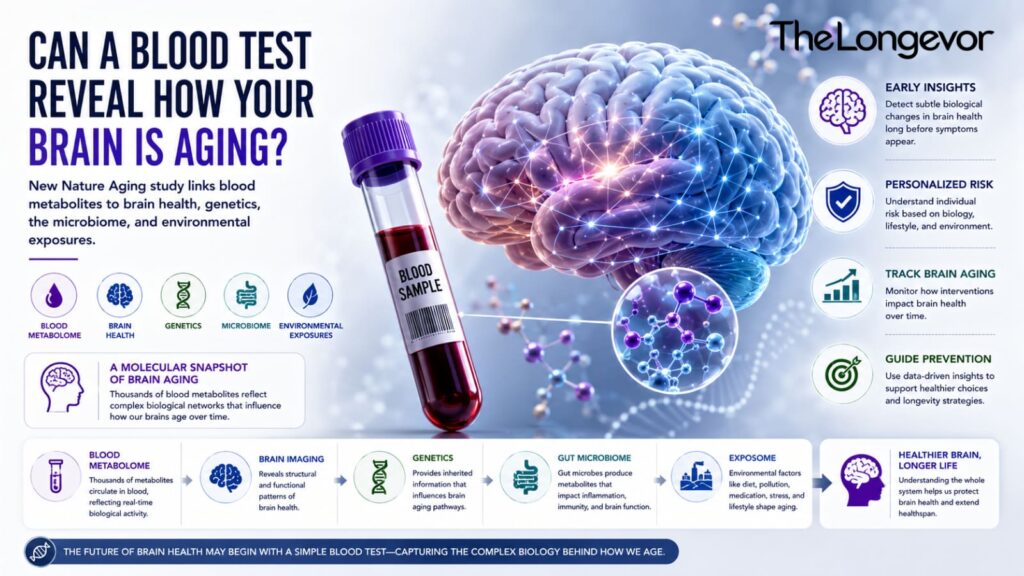
New Nature Aging study links blood metabolites to brain health, genetics, the microbiome, and environmental exposures. For decades, scientists have searched for reliable ways to measure how the brain ages before memory problems or neurodegenerative diseases become clinically apparent.
Brain scans can reveal structural changes. Cognitive tests measure performance. Genetic analyses identify inherited risk. But what if a simple blood sample could provide an early molecular snapshot of brain health?
A new study published in Nature Aging moves that possibility one step closer. Researchers analyzed thousands of blood metabolites alongside brain imaging, genetics, gut microbiome profiles, lifestyle factors, and environmental exposures to identify molecular signatures associated with brain aging.
Rather than focusing on a single biomarker, the study reveals that brain health emerges from a complex biological network influenced by both our biology and the environments we live in. The findings raise an important question:
Could the future of brain health begin with a blood test?
What Happened?
Researchers set out to investigate whether molecules circulating in the bloodstream could provide insight into the biological health of the brain during midlife.
To do this, they analyzed the blood metabolome—the collection of thousands of small molecules produced through normal metabolic processes. These metabolites reflect the body’s current physiological state and are influenced by genetics, diet, gut microbes, medications, lifestyle, and environmental exposures.
The researchers integrated multiple layers of biological data, including:
- Blood metabolomics
- Brain imaging
- Genetic information
- Gut microbiome profiles
- Environmental exposures (the exposome)
By combining these datasets, they identified metabolic patterns associated with healthier and less healthy brain aging. Importantly, the study found that brain-related metabolic signatures were not driven by genetics alone. Gut microbes, environmental factors, and lifestyle exposures also appeared to shape the circulating metabolites linked to brain health.
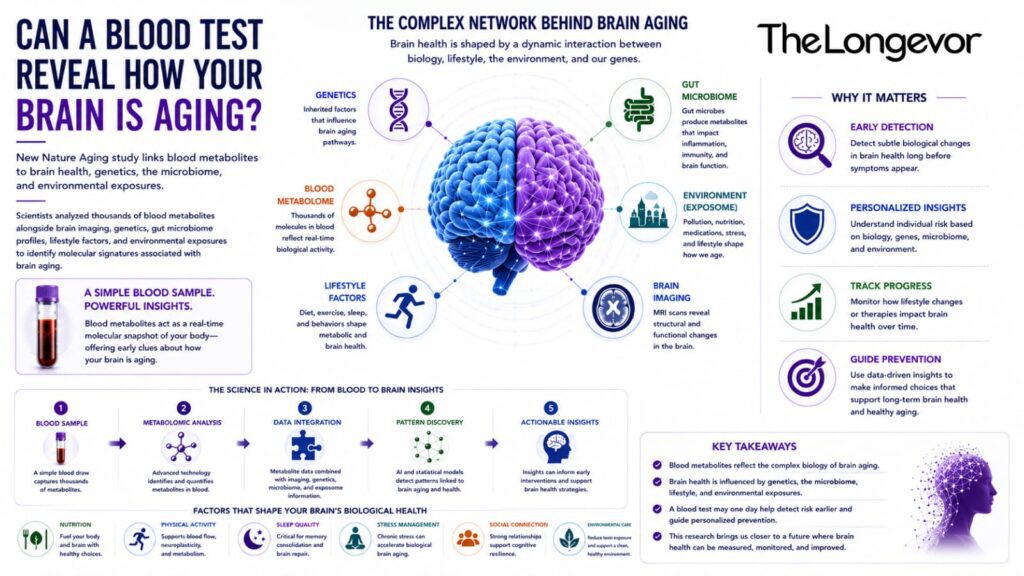
Rather than identifying a single “brain aging molecule,” the researchers demonstrated that brain health reflects the interaction of numerous biological systems operating simultaneously.
The Science Behind It
Every organ in the body continuously releases small molecules into the bloodstream. These molecules—known as metabolites—are products of ongoing biological activity. They include amino acids, lipids, sugars, fatty acids, and hundreds of other compounds involved in energy production, inflammation, immune regulation, and cellular communication.
Collectively, these molecules form the metabolome, a dynamic snapshot of what is happening inside the body at a given moment. Unlike DNA, which remains largely unchanged throughout life, the metabolome responds continuously to internal biology and external influences. Diet changes it. Exercise changes it. Sleep changes it.
Even the microorganisms living inside the gut contribute metabolites that circulate throughout the body. This makes metabolomics particularly attractive for longevity research. Instead of measuring inherited risk alone, scientists can observe how genetics, environment, and lifestyle interact in real time.
The current study also examined the exposome—the totality of environmental exposures experienced throughout life, including nutrition, pollution, medications, smoking, physical activity, and socioeconomic factors. Together with the gut microbiome, these influences appeared to shape many of the metabolites associated with brain health.
The findings reinforce an increasingly accepted concept in aging biology The brain does not age in isolation. Its health is influenced by metabolism, immune function, the gut microbiome, and environmental exposures acting together over decades.
Why It Matters for Longevity
One of the biggest challenges in longevity science is measuring biological aging before disease develops. Neurodegenerative disorders such as Alzheimer’s disease often begin years—or even decades—before symptoms appear. If researchers can identify blood-based metabolic signatures that reflect early changes in brain health, they may eventually be able to detect elevated risk much sooner than is currently possible.
That could have profound implications.Future clinical trials could use metabolomic biomarkers to evaluate whether interventions such as exercise, dietary changes, or emerging longevity therapies are improving brain health long before cognitive decline becomes measurable.
The study also highlights another important shift occurring across geroscience. Researchers are increasingly moving away from searching for single “aging genes” or isolated biomarkers.
Instead, aging is being viewed as a systems-level process emerging from interactions between genetics, metabolism, the microbiome, environmental exposures, and lifestyle. Understanding those interactions may prove just as important as discovering entirely new therapies.
What We Still Don’t Know
Although the findings are promising, important questions remain. This study identified associations between blood metabolites and brain health, but it cannot determine whether those metabolites actively drive brain aging or simply reflect ongoing biological changes.
It is also unclear whether modifying these metabolic pathways will improve long-term cognitive outcomes. Future research will need to answer several critical questions:
- Which metabolites are the strongest predictors of future cognitive decline?
- Can lifestyle interventions alter these metabolomic signatures?
- How does the gut microbiome influence brain aging over time?
- Could metabolomic biomarkers eventually become part of routine preventive healthcare?
Longitudinal studies and clinical trials will be needed before metabolomic testing can be used to guide individual treatment decisions.
Conclusion
The search for reliable biomarkers of brain aging is one of the defining challenges of modern longevity science.This new Nature Aging study suggests that the answers may not lie within a single molecule but within the complex interactions between metabolism, genetics, the gut microbiome, and the environments we inhabit.
Rather than treating brain aging as an isolated neurological process, the research paints a broader picture—one in which the brain reflects the health of the entire biological system.
A simple blood test will not replace brain imaging or clinical evaluation anytime soon.But as metabolomics continues to evolve, the molecules circulating through our bloodstream may become some of the earliest indicators of how well our brains are aging.
The blood metabolome is the complete collection of small molecules circulating in the bloodstream, including amino acids, lipids, sugars, and other metabolic compounds that reflect the body’s current physiological state.
Metabolomics allows researchers to measure real-time biological activity, helping identify molecular patterns associated with healthy brain aging and cognitive decline.
No. The study identified associations between blood metabolites and brain health, but more research is needed before metabolomic tests can be used as clinical diagnostic tools.