
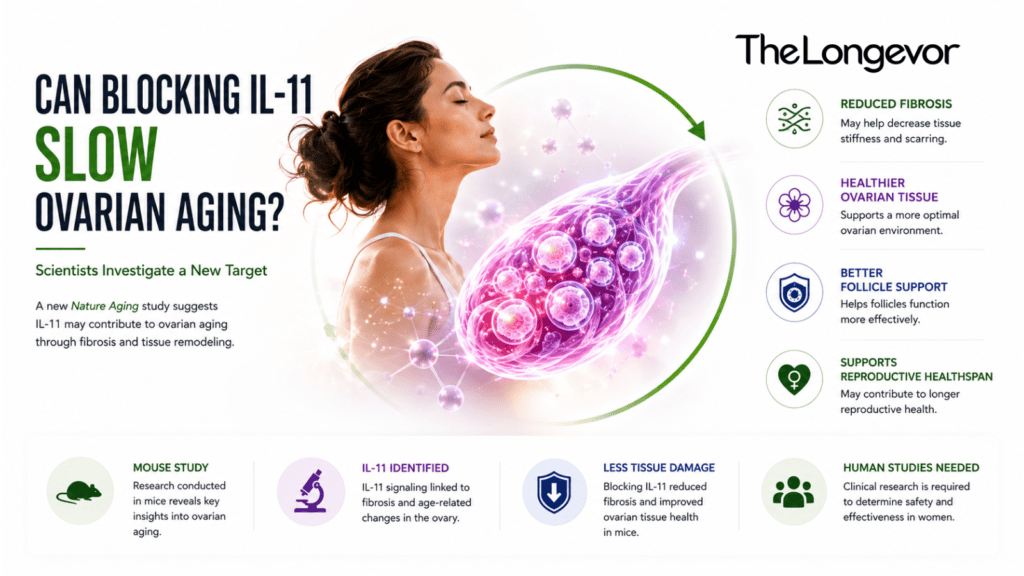
Can Blocking IL-11 Slow Ovarian Aging? Scientists Investigate a New Target
Why do the ovaries age faster than almost any other organ in the human body?Unlike the heart or the brain, reproductive function begins to decline decades before most people experience the effects of old age. Fertility gradually falls, menopause marks the end of ovarian function, and declining hormone production influences everything from bone health to cardiovascular risk.
For years, scientists have tried to understand what drives this process. Is ovarian aging simply an unavoidable consequence of time, or are there biological pathways that could eventually be modified?A new study published in Nature Aging points to one possible answer. Researchers have identified interleukin-11 (IL-11)—a signaling molecule involved in inflammation and tissue remodeling—as a key contributor to ovarian aging in mice. Their findings suggest that blocking this pathway may help preserve ovarian function and slow some of the biological changes associated with reproductive aging.
While the work remains preclinical, it opens an intriguing window into one of longevity science’s most important questions: can we extend not only lifespan, but reproductive healthspan?
What Happened?
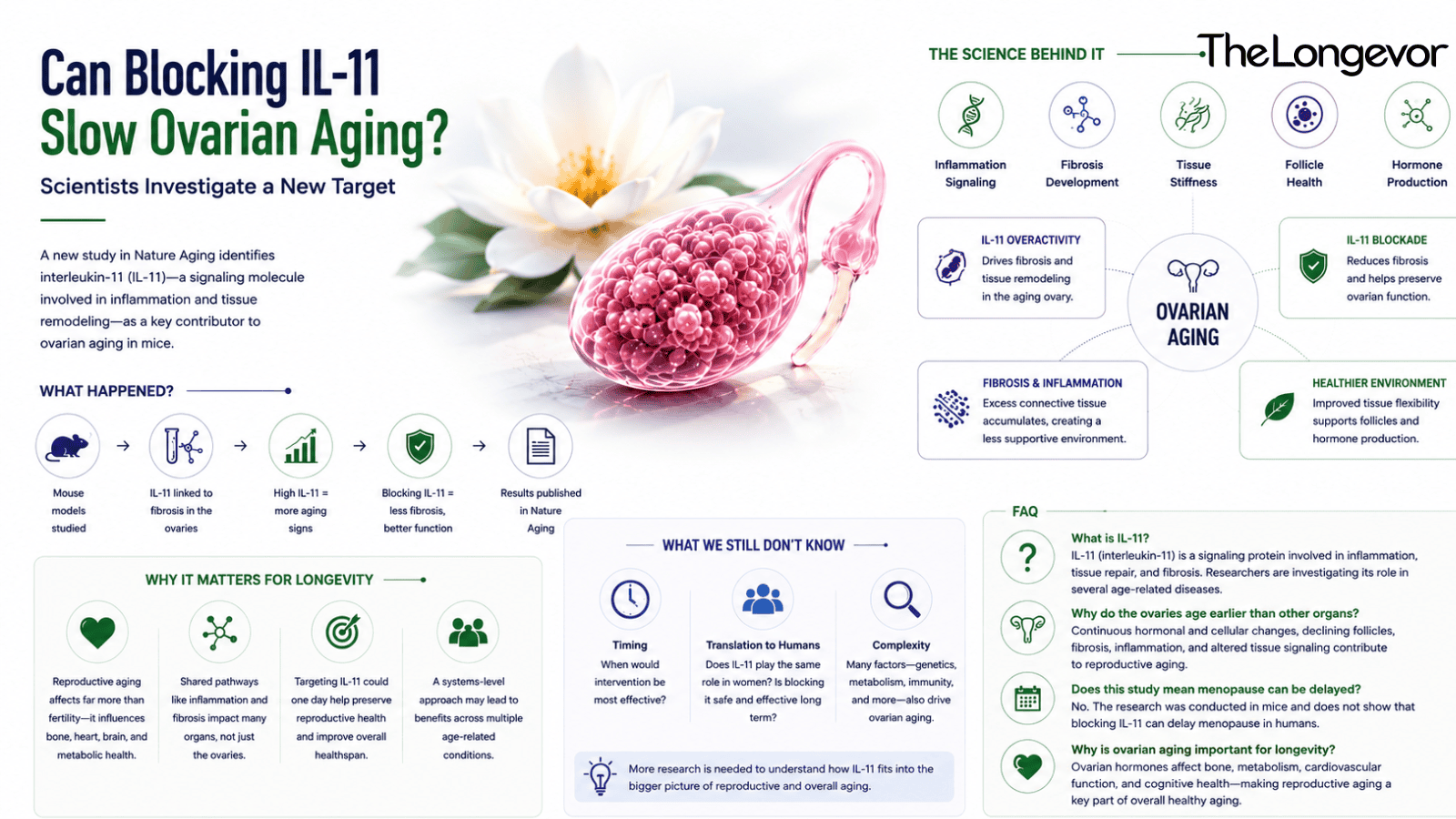
Researchers investigated how IL-11 influences the aging ovary using mouse models and molecular analyses of ovarian tissue.
Previous research had already linked IL-11 to fibrosis—the excessive buildup of connective tissue that gradually reduces the flexibility and function of organs such as the heart, lungs, liver, and kidneys. The team wanted to determine whether the same process contributes to reproductive aging.
Their findings suggest that it does.
As IL-11 activity increased, the ovaries developed greater tissue stiffness and fibrosis, creating an environment that was less supportive of healthy follicles and hormone production. Animals with elevated IL-11 signaling showed more pronounced signs of ovarian aging.
When researchers blocked the IL-11 pathway, many of these age-related changes were reduced. Ovarian tissue appeared healthier, fibrosis declined, and several biological markers associated with ovarian function improved.
Rather than identifying a single cause of reproductive aging, the study suggests that IL-11 may act as an important regulator of the tissue remodeling processes that accompany aging.
The Science Behind It
Although ovarian aging is often discussed in terms of declining egg numbers, the story is much more complex. The ovary is a dynamic organ that depends on constant communication between follicles, blood vessels, immune cells, connective tissue, and hormone-producing cells. As these systems become disrupted with age, the ovarian environment gradually becomes less capable of supporting healthy reproductive function.
One process receiving increasing attention is fibrosis. Fibrosis occurs when excessive connective tissue accumulates within an organ, reducing its flexibility and impairing normal function. While this response is helpful during wound healing, chronic fibrosis can contribute to progressive organ decline.
IL-11 appears to be one of the molecules driving this process.
Normally involved in tissue repair and inflammatory signaling, IL-11 can become overactive with age, stimulating fibroblasts to produce excessive amounts of collagen and other structural proteins. The result is a stiffer ovarian environment that may interfere with follicle development and hormone production.
The implications extend beyond fertility.
The ovaries produce estrogen and other hormones that influence bone density, cardiovascular health, metabolism, and brain function. Their decline therefore affects multiple systems throughout the body, making ovarian aging an important component of overall healthspan.
Rather than viewing menopause as an isolated reproductive event, scientists increasingly see it as part of broader biological aging.
Why It Matters for Longevity
Longevity science has traditionally focused on organs such as the brain, heart, and immune system. Reproductive aging has received far less attention despite its profound influence on long-term health. This study highlights why that perspective may be changing.
If inflammatory pathways like IL-11 contribute to ovarian aging, they could eventually become therapeutic targets for preserving reproductive function and reducing some of the broader health consequences associated with menopause.
More importantly, the findings reinforce a central principle of geroscience: aging is driven by shared biological mechanisms that often affect multiple organs simultaneously.
Fibrosis, chronic inflammation, and altered cellular signaling are not unique to the ovaries. They also contribute to cardiovascular disease, kidney dysfunction, pulmonary fibrosis, and numerous other age-related conditions.
Understanding these shared pathways may ultimately lead to interventions that improve health across several organ systems rather than treating each disease individually. For longevity researchers, that systems-level perspective is becoming increasingly important.
What We Still Don’t Know
Despite the excitement surrounding the findings, several important questions remain.
The study was conducted in mice, and human ovarian aging is considerably more complex. Researchers do not yet know whether IL-11 plays the same role in women or whether blocking the pathway would safely preserve reproductive function over the long term.
It also remains unclear when intervention would be most effective. Would treatment need to begin years before menopause, or could it reverse existing tissue changes later in life?
Finally, ovarian aging involves far more than fibrosis alone. Genetics, metabolism, immune function, mitochondrial health, and environmental factors all contribute to reproductive decline.
Future clinical studies will be needed to determine whether targeting IL-11 can meaningfully influence these interconnected processes.
Conclusion
For decades, ovarian aging has been viewed as an inevitable consequence of time. This study challenges that assumption by identifying a biological pathway that may actively drive the process.
Blocking IL-11 is far from becoming a clinical therapy, and much remains to be learned before these findings can be translated into human medicine. Yet the research reflects a broader shift taking place across longevity science.
Rather than accepting aging as an untouchable process, scientists are beginning to identify the molecular signals that shape how—and perhaps how quickly—our organs grow old.
For the ovaries, IL-11 may represent one of those signals. Whether modifying it can ultimately extend reproductive healthspan is a question future research will now be compelled to answer.
Current evidence suggests regular exercise may slow several molecular processes associated with aging, although it has not been proven to stop or reverse aging.
Molecular aging refers to the gradual changes in genes, proteins, metabolism, and cellular function that occur as tissues grow older.
Mitochondria produce the energy needed for cellular function. Their decline is associated with reduced muscle function, metabolic dysfunction, and several age-related diseases.
Multi-omics combines multiple biological analyses—such as genomics, proteomics, and metabolomics—to provide a comprehensive view of how cells function and change over time.