
Longevity’s Measurement Problem: Why Scientists Want an Open Competition for Aging Biomarkers
For centuries, aging research faced a deceptively simple challenge: waiting. Researchers seeking to determine whether an intervention extended lifespan often had to wait years—or decades—for results. Even today, proving that a therapy slows human aging remains extraordinarily difficult because aging unfolds over long timescales.
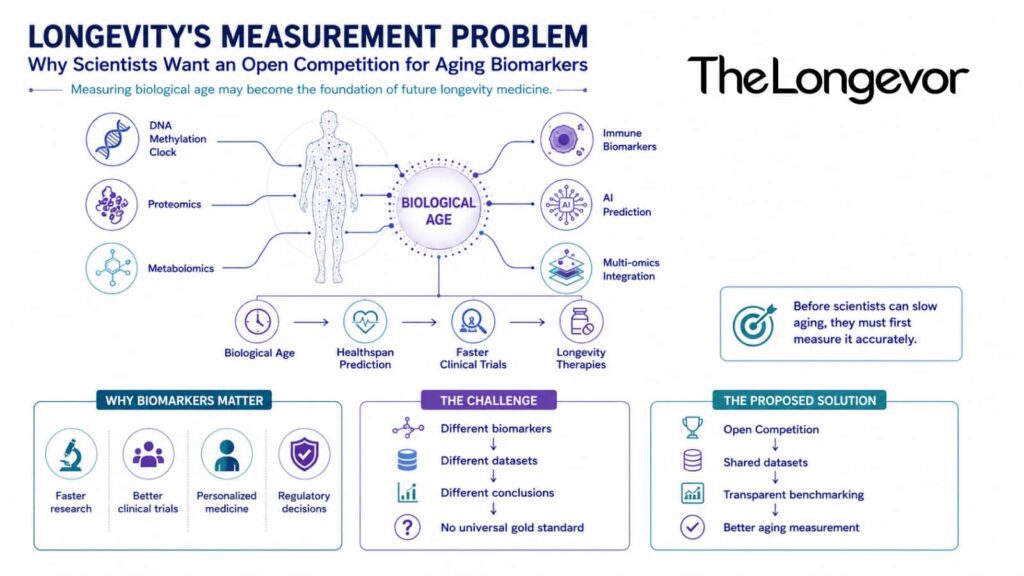
This challenge has elevated aging biomarkers into one of the most important areas of modern geroscience. If scientists could reliably measure biological aging, they could evaluate interventions in months rather than decades. Yet despite enormous progress in epigenetics, proteomics, metabolomics, and artificial intelligence, no universal gold standard exists.
A new proposal published in Nature Aging seeks to address that problem through an open competition for aging biomarkers. The initiative may sound technical, but its implications extend across longevity biotechnology, clinical research, regulatory science, and investment.
At stake is a question that could shape the future of the field: how do we know whether someone is aging faster—or slower—than expected?
What Happened?
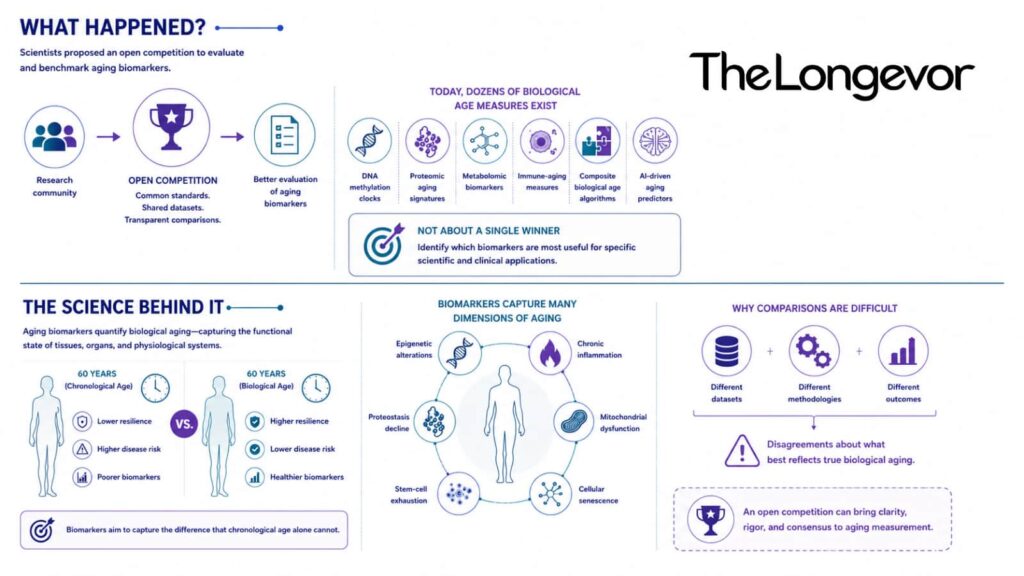
Researchers led by prominent aging scientists proposed a community-wide competition designed to evaluate and benchmark biological aging biomarkers.
The goal is straightforward. Rather than allowing different groups to assess biomarkers using separate datasets and methodologies, the competition would establish common standards and transparent comparisons.
Today, dozens of biological age measures exist. These include:
- DNA methylation clocks
- Proteomic aging signatures
- Metabolomic biomarkers
- Immune-aging measures
- Composite biological age algorithms
- AI-driven aging predictors
Each approach claims advantages, but direct comparisons remain difficult. The proposed framework would create standardized evaluation criteria and shared datasets, enabling researchers to determine which biomarkers perform best under specific conditions.
Importantly, the initiative is not focused on identifying a single winner. Instead, it aims to understand which biomarkers are most useful for particular scientific and clinical applications.
The Science Behind It
Aging biomarkers attempt to quantify biological aging rather than chronological age. Chronological age simply measures time.
Biological age seeks to estimate the functional state of tissues, organs, and physiological systems. Two individuals may both be 60 years old while exhibiting dramatically different levels of health, resilience, and disease risk.
Biomarkers attempt to capture that difference. DNA methylation clocks are among the most famous examples. By analyzing age-related epigenetic changes, these tools can estimate biological age with remarkable accuracy.
However, methylation is only one aspect of aging. Other researchers focus on:
- Circulating proteins
- Immune-cell composition
- Metabolic profiles
- Inflammatory markers
- Organ-specific measures
- Multi-omics integration
The challenge is that aging itself is multidimensional. Different biomarkers may capture different hallmarks of aging, including:
- Epigenetic alterations
- Chronic inflammation
- Mitochondrial dysfunction
- Cellular senescence
- Stem-cell exhaustion
- Proteostasis decline
As a result, disagreements frequently arise regarding which measurements best reflect true biological aging. An open competition could help clarify these distinctions.
How Strong Is The Evidence?
This is not a clinical trial or biological discovery. Instead, it is an infrastructure proposal designed to improve scientific rigor across the field. Its strength lies in addressing reproducibility and standardization.
The proposal reflects growing recognition that longevity science requires shared benchmarks comparable to those used in fields such as genomics, machine learning, and drug development. Whether the initiative succeeds will depend on participation, transparency, and dataset quality.
Why It Matters for Longevity
Few issues are more important to the future of geroscience. Consider nearly every major longevity question:
- Do senolytics slow biological aging?
- Does time-restricted feeding improve healthspan?
- Can exercise reduce biological age?
- Do longevity drugs work?
Each question ultimately depends on measurement. Without reliable biomarkers, researchers must rely on disease outcomes or lifespan data that may take years to accumulate. For biotechnology companies, validated biomarkers could dramatically accelerate therapeutic development. For regulators, they may provide future surrogate endpoints.
For investors, they offer a way to distinguish robust science from unsupported claims. The field’s ability to measure aging accurately may ultimately determine how quickly interventions reach clinical practice.
What We Still Don’t Know
Several important questions remain. Should aging be measured using a single biomarker or multiple complementary systems? Can one biomarker perform equally well across diverse populations? What endpoints should define success?
Researchers must also determine whether biomarkers predict future health outcomes or merely correlate with them. The distinction is crucial. A useful biomarker should not only track aging—it should meaningfully predict clinically relevant outcomes.
Future Outlook
Over the next five years, open benchmarking initiatives are likely to become increasingly common in aging research. Within a decade, validated biomarker panels may become routine tools in clinical trials targeting aging biology.
Twenty years from now, biological age measurements could be as common as cholesterol testing—provided the field establishes rigorous standards today. The competition proposed in Nature Aging represents an important step toward that future.
Conclusion
The future of longevity science may depend less on discovering new interventions than on learning how to measure aging itself. An open competition for aging biomarkers may not generate headlines like gene therapies or senolytic drugs. Yet it addresses one of the field’s most fundamental challenges.
Before researchers can reliably slow aging, they must first learn how to measure it.
An aging biomarker is a measurable biological signal that reflects aspects of biological aging rather than simply chronological age.
They may allow researchers to evaluate interventions much faster than waiting for disease or lifespan outcomes.
Not necessarily. Different biomarkers capture different aspects of aging biology, which is why comparative benchmarking is needed.