
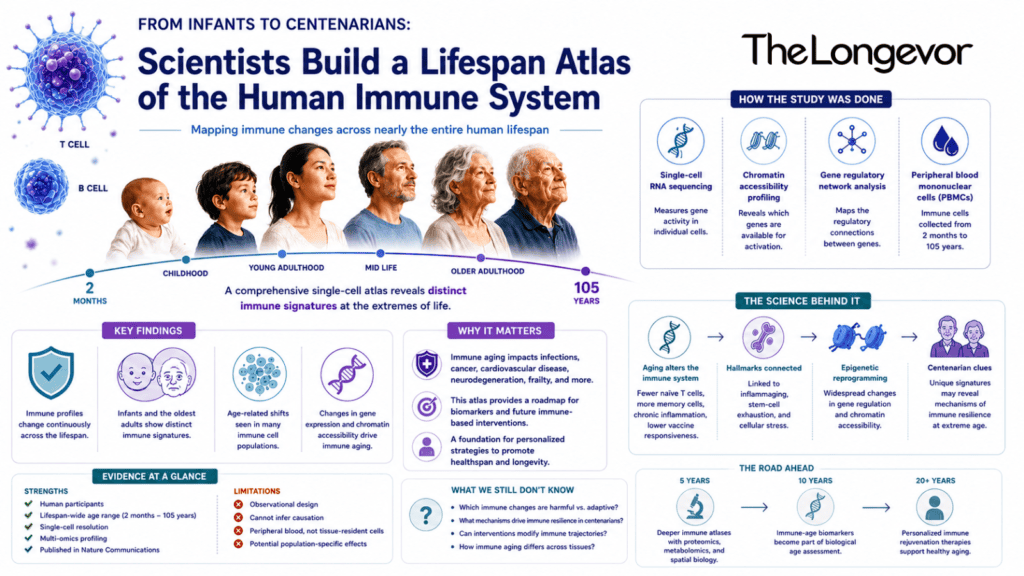
From Infants to Centenarians: Scientists Build a Lifespan Atlas of the Human Immune System
The immune system is often described as the body’s defense network. Yet it is also one of the biological systems most profoundly altered by age.
As people grow older, immune responses become less coordinated, chronic inflammation tends to rise, and protection against infections and vaccines often weakens. These changes contribute not only to infectious disease risk but also to cardiovascular disease, cancer, neurodegeneration, and frailty.
Despite its importance, scientists still lack a complete picture of how the immune system evolves across the human lifespan.
A new study published in Nature Communications takes a major step toward filling that gap. Using advanced single-cell technologies, researchers created a detailed map of immune cells from individuals ranging in age from two months to 105 years.
The resulting atlas reveals distinct immune signatures at both extremes of life and offers new clues about why infants and the oldest adults often share vulnerabilities to infection despite being separated by a century of aging.
What Happened?
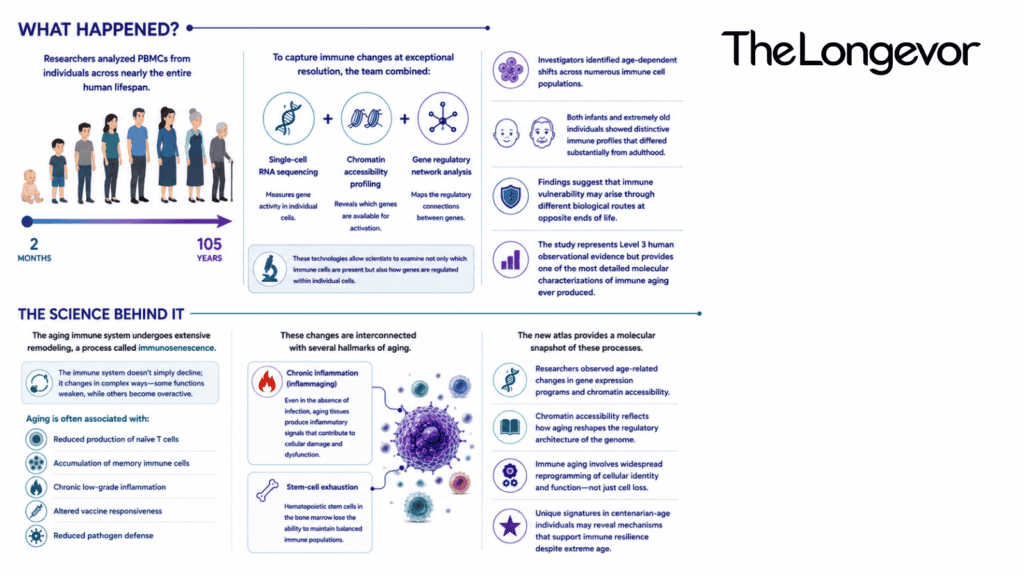
Researchers analyzed peripheral blood mononuclear cells (PBMCs) a diverse collection of circulating immune cells from participants spanning nearly the entire human lifespan.
To capture immune changes at exceptional resolution, the team combined:
- Single-cell RNA sequencing
- Chromatin accessibility profiling
- Gene regulatory network analysis
These technologies allow scientists to examine not only which immune cells are present but also how genes are regulated within individual cells.
The investigators identified age-dependent shifts across numerous immune cell populations.
Perhaps most strikingly, both infants and extremely old individuals displayed distinctive immune profiles that differed substantially from those observed during adulthood.
The findings suggest that immune vulnerability may arise through different biological routes at opposite ends of life.
The study represents Level 3 human observational evidence but provides one of the most detailed molecular characterizations of immune aging ever produced.
The Science Behind It
The aging immune system undergoes extensive remodeling, a process often called immunosenescence.
This term can be misleading because the immune system does not simply decline. Instead, it changes in complex ways.
Some immune functions weaken, while others become overactive.
For example, aging is often associated with:
- Reduced production of naïve T cells
- Accumulation of memory immune cells
- Chronic low-grade inflammation
- Altered vaccine responsiveness
- Reduced pathogen defense
These changes are interconnected with several hallmarks of aging.
One major hallmark is chronic inflammation, sometimes called inflammaging.
Even in the absence of infection, aging tissues frequently produce inflammatory signals that contribute to cellular damage and dysfunction.
Another hallmark involves stem-cell exhaustion.
Hematopoietic stem cells within the bone marrow generate immune cells throughout life. As these stem cells age, their ability to maintain balanced immune populations may decline.
The new atlas provides a molecular snapshot of these processes.
Researchers observed age-related changes in gene expression programs and chromatin accessibility the mechanisms that determine which genes are available for activation.
Chromatin accessibility is particularly important because it reflects how aging reshapes the regulatory architecture of the genome.
The findings suggest that immune aging is not solely a consequence of cell loss but also involves widespread reprogramming of cellular identity and function.
Interestingly, the study found unique signatures among centenarian-age individuals.
These patterns may provide clues about mechanisms that support immune resilience despite extreme age.
How Strong Is The Evidence?
The study is highly rigorous from a molecular biology perspective.
Major strengths include:
- Human participants
- Lifespan-wide age range
- Single-cell resolution
- Multi-omics profiling
- Comprehensive cellular analysis
Limitations include:
- Observational design
- Limited ability to infer causation
- Peripheral blood rather than tissue-resident immune cells
- Potential population-specific effects
The study identifies associations and biological patterns rather than direct causal mechanisms.
Nevertheless, it provides a valuable reference resource for future immune-aging research.
Why It Matters for Longevity
Immune aging is increasingly viewed as a central driver of healthspan.
A declining immune system affects far more than infection risk.
Immune dysfunction influences:
- Cancer surveillance
- Cardiovascular disease
- Neurodegeneration
- Tissue repair
- Vaccine responsiveness
- Frailty
Many longevity interventions including exercise, dietary interventions, senolytics, and emerging therapeutics may exert part of their effects through immune modulation.
Understanding what a healthy aging immune system looks like is therefore essential.
The atlas may also help researchers identify biomarkers capable of distinguishing healthy immune aging from pathological decline.
In the future, such biomarkers could guide personalized interventions designed to preserve immune resilience.
Perhaps most importantly, the study reinforces the idea that longevity is not simply about extending lifespan.
It is about maintaining biological systems capable of responding to stress, injury, and disease throughout life.
The immune system sits at the center of that challenge.
What We Still Don’t Know
Several key questions remain.
Researchers still do not know whether the observed immune signatures actively drive aging or merely reflect broader physiological changes.
The mechanisms responsible for maintaining immune function in centenarians also remain poorly understood.
Future studies will need to determine:
- Which immune changes are harmful
- Which changes are adaptive
- Whether interventions can modify immune trajectories
- How immune aging differs across tissues
Longitudinal studies following individuals over time will be especially important.
Future Outlook
Over the next five years, lifespan immune atlases will likely become increasingly detailed through integration with proteomics, metabolomics, and spatial biology.
Within a decade, immune-age biomarkers may become routine components of biological age assessment.
Twenty years from now, personalized immune rejuvenation strategies could emerge as a major pillar of preventive longevity medicine.
The foundation for those advances will depend on datasets like this one.
Conclusion
The immune system changes continuously throughout life, but those changes have remained difficult to measure with precision.
By mapping immune cells from infancy to age 105, researchers have created one of the most comprehensive portraits of human immune aging to date.
The atlas does not answer every question about longevity. But it provides something equally valuable: a framework for understanding how one of the body’s most important systems evolves across the lifespan and what it may take to preserve it.