
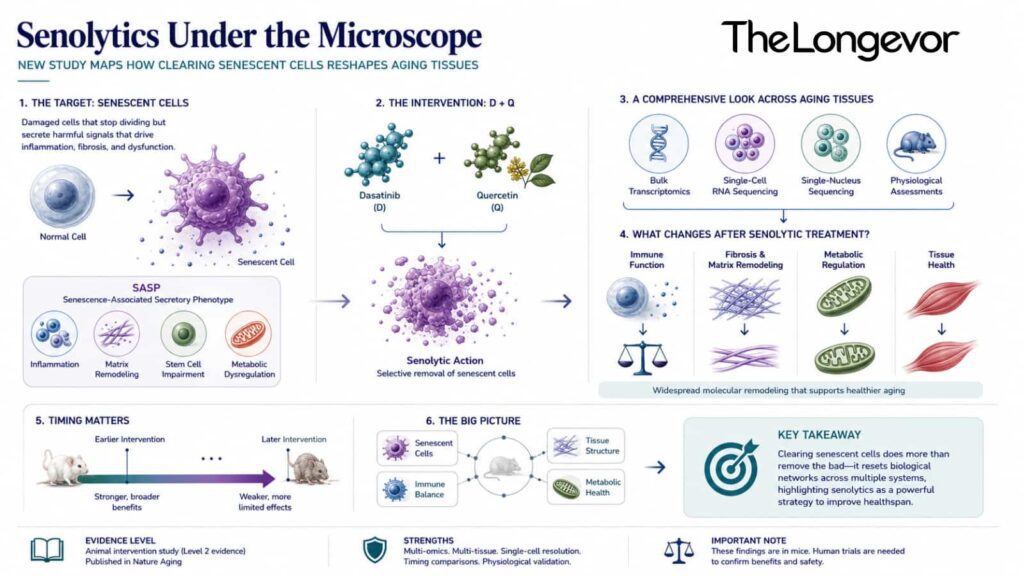
How Senolytics Clear Cellular Senescence
For more than a decade, senolytics drugs have occupied a prominent place in longevity research. Their promise is conceptually straightforward: identify and eliminate senescent cells damaged cells that no longer divide but continue secreting inflammatory molecules that can disrupt surrounding tissues.
Yet despite growing enthusiasm, a critical question has remained unanswered. What exactly happens throughout the body when these cells are removed?
A new study published in Nature Aging offers one of the most detailed answers yet. Using multiple layers of molecular profiling, researchers mapped the effects of the senolytic combination dasatinib and quercetin (D+Q) across aged mice, (senolytics) revealing widespread changes in immune function, tissue fibrosis, and metabolic regulation.
The findings suggest that senolytic interventions may influence aging through broader biological remodeling than previously appreciated. They also highlight a recurring theme in geroscience: timing may be just as important as treatment itself.
What Happened?
Research led by Hou, Chen, and colleagues investigated how D+Q treatment affected aged male mice across multiple tissues.
Rather than focusing on a single organ or disease model, the team performed a comprehensive molecular analysis using:
- Bulk transcriptomics
- Single-cell RNA sequencing
- Single-nucleus sequencing
- Physiological assessments
The goal was to characterize the biological consequences of senescent cell clearance at unprecedented resolution.
The study found that senolytic treatment altered gene-expression programs linked to immune function, extracellular matrix remodeling, fibrosis, and metabolism.
Importantly, intervention timing influenced outcomes.
These findings indicate that senolytics may not simply remove harmful cells. Instead, they appear capable of reshaping biological networks that influence tissue function throughout aging.
The highest level of evidence remains animal intervention research (Level 2 evidence).
The Science Behind Cellular Senescence and Senolytics
Cellular senescence is one of the best-established hallmarks of aging.
Cells enter senescence in response to stressors such as DNA damage, oxidative stress, mitochondrial dysfunction, or repeated cell division.
Initially, senescence serves protective purposes by preventing damaged cells from becoming cancerous.
The problem emerges when senescent cells accumulate.
These cells release inflammatory molecules, growth factors, and tissue-remodeling signals collectively known as the senescence-associated secretory phenotype (SASP).
The SASP can create chronic low-grade inflammation, disrupt stem-cell function, impair tissue regeneration, and promote fibrosis.
Senolytics attempt to selectively eliminate these dysfunctional cells.
Dasatinib, originally developed as a cancer therapy, and quercetin, a naturally occurring flavonoid, form one of the most widely studied senolytic combinations.
The new study reveals that their effects extend beyond simple cell removal.
Researchers observed significant remodeling of immune pathways. Aging is often accompanied by immune dysfunction, sometimes called immunosenescence, characterized by impaired pathogen defense alongside persistent inflammation.
Following senolytic treatment, immune-related gene-expression programs shifted toward a healthier profile.
The investigators also identified changes in fibrosis-related pathways.
Fibrosis refers to excessive accumulation of scar-like connective tissue. It contributes to declining organ function in aging lungs, heart, liver, kidneys, and skeletal muscle.
Reduction of fibrotic signatures suggests senescent cells may play a central role in maintaining tissue scarring.
Metabolic pathways were similarly affected.
This observation aligns with growing evidence that senescence influences energy utilization, mitochondrial health, and nutrient sensing throughout the body.
Together, these findings support an emerging model in which senescent cells act as biological amplifiers of aging rather than isolated pathological features.
How Strong Is The Evidence?
The evidence is strong within a preclinical context.
Key strengths include:
- Multi-tissue analysis
- Single-cell resolution
- Longitudinal intervention comparisons
- Physiological validation
- Comprehensive molecular characterization
However, important limitations remain.
The study was conducted in mice.
Not all senescent cells are harmful, and some contribute to wound healing and tissue repair. Eliminating them indiscriminately could potentially create unintended consequences.
Furthermore, senolytic responses may differ substantially between species and among human populations.
The study demonstrates causation within an animal model and provides mechanistic insight, but does not establish clinical efficacy.
Why Senolytics Matters for Longevity
Few therapeutic approaches in geroscience have generated as much excitement as senolytics.
Unlike disease-specific treatments, senolytics target a fundamental aging mechanism that contributes to multiple age-related conditions simultaneously.
The new findings strengthen the biological rationale for this strategy.
Rather than producing isolated effects, senolytic interventions appear capable of influencing interconnected systems involved in inflammation, tissue maintenance, and metabolic regulation.
This systems-level perspective is important.
Aging is increasingly understood as a network phenomenon involving interactions between multiple hallmarks rather than independent biological defects.
The study suggests senescent cells may occupy a central position within that network.
For longevity biotechnology companies, these data provide valuable clues regarding biomarkers, therapeutic timing, and tissue-specific responses.
For clinicians and regulators, they offer a clearer framework for evaluating future senolytic therapies.
Most importantly, the research moves the field closer to understanding how interventions targeting aging biology exert their effects.
What We Still Don’t Know
Several questions remain unresolved.
Researchers do not yet know which tissues derive the greatest benefit from senolytic therapy.
Optimal dosing schedules also remain uncertain.
Equally important is the issue of safety. Senescent cells can play beneficial roles in tissue repair and development, meaning complete elimination may not always be desirable.
Future studies must determine:
- Which senescent cell populations should be targeted
- Which biomarkers best predict response
- Whether benefits translate to humans
- Long-term safety profiles
Human clinical trials will ultimately determine the therapeutic potential of senolytic approaches.
Future Outlook
Over the next five years, molecular atlases like this study will likely guide the design of next-generation senolytic drugs.
Within a decade, tissue-specific senolytics may emerge that selectively target harmful senescent cell populations while preserving beneficial functions.
Twenty years from now, senescence-targeting therapies could become a standard component of preventive geriatric medicine if efficacy and safety are demonstrated in humans.
For now, the field remains in the translational phase, but the scientific foundation continues to strengthen.
Conclusion
The importance of this study lies not only in demonstrating that senolytics work in mice, but in revealing how they work. By mapping the biological ripple effects of senescent cell clearance across aging tissues, researchers have provided one of the clearest pictures yet of how targeting a single hallmark of aging can influence multiple interconnected systems. The findings reinforce a central idea of modern geroscience: aging may be complex, but some of its most important drivers are increasingly becoming measurable and potentially modifiable.