
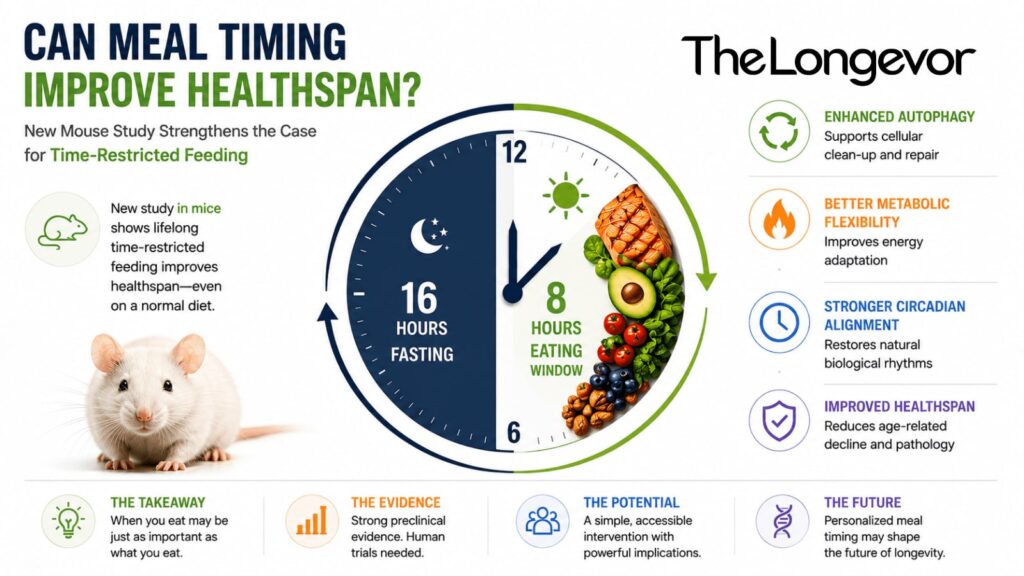
Can Meal Timing Improve Healthspan? New Mouse Study Strengthens the Case for Time-Restricted Feeding
For decades, nutrition research has focused primarily on what we eat and how much we consume. Increasingly, however, scientists are asking a different question: when should we eat?
A new study highlighted in Nature Aging suggests that meal timing alone may meaningfully influence how organisms age. Researchers found that lifelong time-restricted feeding (TRF) improved several measures of healthspan in mice, even when animals consumed a standard, non-obesogenic diet.
The findings add to growing evidence that aligning food intake with biological rhythms may affect aging biology independently of calorie restriction. While the work was conducted in mice and cannot yet be directly translated to humans, it strengthens the scientific foundation behind one of the most widely discussed interventions in longevity research.
The study also highlights an important distinction: healthspan the period of life spent in good health may be influenced not only by dietary composition but also by the timing of nutrient exposure.
What Happened?
The research, conducted by Iiams and colleagues and discussed in Nature Aging, investigated the long-term effects of time-restricted feeding in mice.
Unlike many previous studies focused on obesity or high-fat diets, this experiment examined mice consuming a standard laboratory diet. Researchers restricted food access to specific daily windows while maintaining overall nutrition.
The goal was to isolate the effects of meal timing from confounding factors such as weight loss or caloric restriction.
The investigators observed improvements in several measures associated with healthy aging. Benefits varied by sex and included reductions in age-related pathology and improvements in markers associated with physiological function.
Notably, some outcomes extended beyond metabolic health and appeared to influence broader aging processes.
The highest level of evidence remains animal-based intervention research (Level 2 evidence). Human clinical confirmation is still required.
Nevertheless, the study provides some of the strongest lifespan-long data supporting the role of feeding schedules in healthy aging.
The Science Behind It
Time-restricted feeding works through a surprisingly simple principle.
Organisms evolved under predictable cycles of feeding and fasting. These cycles synchronize biological clocks present throughout nearly every tissue in the body.
Modern eating patterns often extend food intake across 14–16 hours per day, reducing the duration of fasting periods during which maintenance and repair processes occur.
Several aging-related pathways may be influenced by feeding schedules.
One is autophagy, a cellular recycling process that removes damaged proteins and dysfunctional cellular components. Autophagy generally increases during fasting and is considered an important mechanism for maintaining cellular health.
Another pathway involves metabolic flexibility the body’s ability to switch efficiently between fuel sources. Aging is frequently associated with declining metabolic adaptability.
Circadian rhythms also play a central role.
The body’s internal clocks regulate hormone secretion, energy metabolism, immune function, DNA repair, and cellular stress responses. Disruption of circadian rhythms has been linked to obesity, cardiovascular disease, cancer risk, and accelerated biological aging.
By consolidating food intake into a predictable daily window, TRF may reinforce these natural biological rhythms.
Researchers increasingly suspect that aging is partly a problem of declining temporal organization. Cellular systems become less synchronized, reducing the efficiency of repair and maintenance processes.
Time-restricted feeding may therefore act not by introducing something new into the body, but by restoring biological timing that evolved over millions of years.
How Strong Is the Evidence?
The study represents strong preclinical evidence.
Major strengths include:
- Lifelong intervention design
- Standard diet rather than obesity-focused models
- Detailed pathology assessment
- Examination of multiple aging-related outcomes
Important limitations remain.
The study was conducted in mice, whose metabolism differs significantly from humans.
Additionally, feeding schedules that are practical in laboratory settings may not be feasible for many people.
The evidence supports causal effects in mice but cannot establish human efficacy.
At present, the findings should be viewed as preclinical but highly translational.
Why It Matters for Longevity
Among longevity interventions, time-restricted feeding occupies a unique position.
Unlike experimental drugs, gene therapies, or cellular reprogramming approaches, meal timing can be implemented immediately without specialized technology.
That accessibility has fueled enormous public interest. Unfortunately, human evidence has often lagged behind enthusiasm.
This study helps close part of that gap by demonstrating that meal timing may influence aging biology even in the absence of obesity.
The implications extend beyond weight management.
Researchers increasingly view aging as a systemic process involving metabolism, inflammation, cellular maintenance, and circadian regulation. Time-restricted feeding appears capable of influencing several of these systems simultaneously.
For preventive medicine, this raises an intriguing possibility: future dietary guidelines may eventually incorporate not only nutritional quality but also timing recommendations designed to support healthy aging.
The work also reinforces a broader principle emerging across geroscience—that biological timing itself may be an important determinant of longevity.
What We Still Don’t Know
Several critical questions remain.
Researchers do not yet know which feeding windows are optimal for humans.
It is also unclear whether benefits differ based on age, sex, genetics, activity levels, or underlying metabolic health.
Long-term randomized controlled trials are needed to determine whether time-restricted feeding meaningfully affects biological aging markers, disease incidence, or healthspan in humans.
The field must also distinguish between benefits arising from fasting itself and those resulting from improved circadian alignment.
Future Outlook
Over the next five years, larger human studies will likely refine our understanding of optimal feeding schedules.
Within a decade, biological age measurements may be incorporated into nutrition trials to assess long-term effects more precisely.
Looking twenty years ahead, personalized meal-timing strategies could become a routine component of preventive medicine and longevity-focused healthcare.
Whether time-restricted feeding ultimately becomes a cornerstone of healthy aging will depend on evidence emerging from human intervention studies.
Conclusion
The most important lesson from this study may be that aging biology is not governed solely by what enters the body, but by when it enters.