
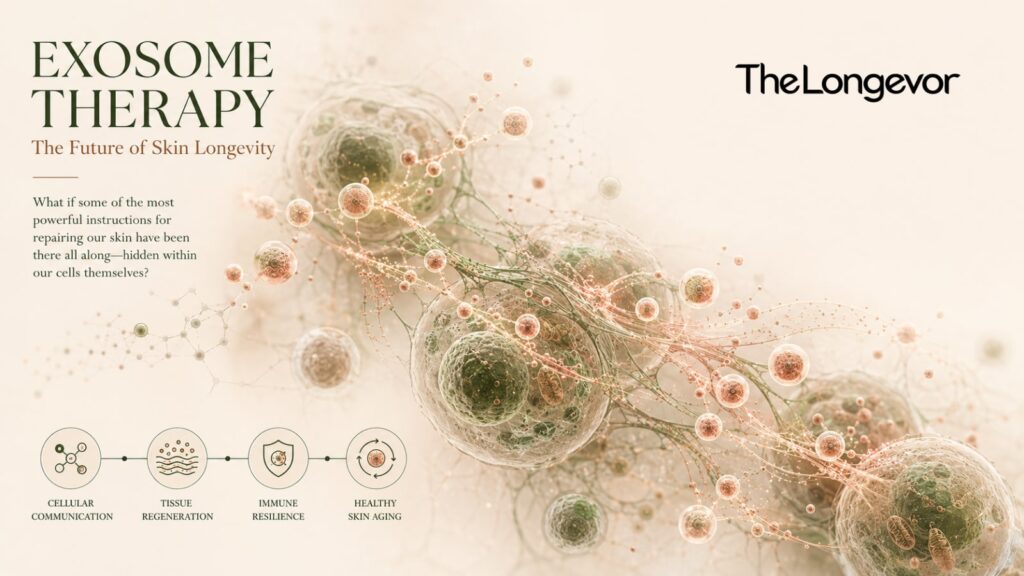
Exosome Therapy: The Future of Skin Longevity
Every time you recover from a minor injury, repair environmental damage, or replace aging cells, billions of microscopic conversations take place beneath the surface of your skin. Cells are constantly exchanging biological instructions that determine when to repair, regenerate, or mount an immune response. Most of these conversations happen without us ever noticing.
Until they don’t. As we age, our skin gradually loses some of its remarkable regenerative capacity. Collagen production declines. Cellular communication becomes less efficient. Chronic low-grade inflammation accumulates over time, while tissue repair becomes slower and less precise.
The visible signs of skin aging are simply the final chapter of a much larger biological story. For decades, skincare has focused largely on treating what we can see. Longevity science is beginning to ask a different question.
What if healthy skin aging isn’t simply about replacing what’s lost but helping our cells communicate better? That question is attracting growing scientific interest toward one of regenerative medicine’s most fascinating discoveries is Exosome Therapy.
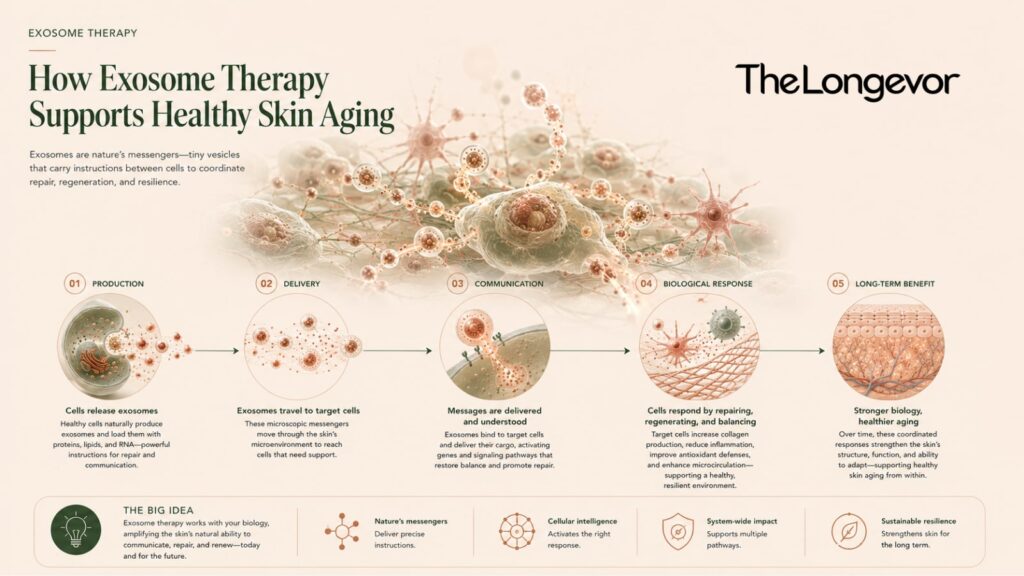
Invisible to the naked eye and thousands of times smaller than the width of a human hair, exosomes are microscopic biological messengers that allow cells to communicate with one another. Researchers are increasingly investigating their role in tissue regeneration, wound healing, inflammation, and healthy aging.
Could these tiny biological packages someday become part of the future of skin longevity? The science is still evolving, but it is beginning to reveal some intriguing possibilities.
What Are Exosomes?
For years, scientists believed cells communicated primarily through hormones, proteins, and direct cellular interactions. Today, we know that cells also communicate through microscopic extracellular vesicles known as exosomes. These biological messengers carry important molecular cargo, including:
- Proteins
- Lipids
- Growth factors
- Messenger RNA (mRNA)
- MicroRNAs involved in cellular regulation
Think of exosomes as microscopic delivery systems carrying biological instructions throughout the body. They influence processes involved in:
- Tissue repair
- Immune regulation
- Cellular signaling
- Inflammation
- Wound healing
- Regeneration
Every day, trillions of these biological messages are exchanged throughout our bodies. Researchers are now asking whether harnessing some of these regenerative signals may help support healthier skin aging.
Why Does Our Skin Age?
Skin aging is often described as collagen loss or wrinkle formation. In reality, it is considerably more complex.Healthy skin depends upon the coordinated function of multiple biological systems, including:
- Cellular repair pathways
- Collagen production
- Immune resilience
- Mitochondrial function
- Microcirculation
- Stem cell activity
- Inflammatory regulation
As we age, these systems gradually become less efficient. Researchers have identified several biological processes involved in skin aging, including:
- Cellular senescence
- Chronic inflammation (inflammaging)
- Mitochondrial dysfunction
- Stem cell exhaustion
- Impaired tissue regeneration
- Altered cellular communication
Many of these mechanisms overlap closely with the hallmarks of aging recognized throughout longevity science. Skin aging, it turns out, is longevity biology made visible.
Can Exosome Therapy Support Healthy Skin Aging?
The growing interest surrounding Exosome Therapy extends far beyond cosmetic applications. Researchers are investigating whether exosomes may influence several biological processes involved in healthy skin aging, including:
- Collagen remodeling
- Tissue regeneration
- Inflammatory regulation
- Cellular communication
- Wound healing responses
- Skin barrier function
- Cellular resilience
Unlike interventions designed solely to improve appearance, regenerative medicine aims to support the biological systems that allow tissues to function optimally throughout life. This is precisely why longevity medicine is paying attention. The goal isn’t necessarily to make our skin look younger. It is to understand how we might preserve its remarkable capacity for repair and resilience for longer.
What Does Current Research Tell Us?
Early research surrounding Exosome Therapy is encouraging, particularly in regenerative medicine and tissue repair. Preclinical studies have demonstrated promising findings involving:
- Collagen production
- Tissue regeneration
- Wound healing
- Inflammatory signaling
- Skin repair mechanisms
Several early clinical studies have also reported improvements in skin quality and regenerative responses following exosome-based interventions. However, an important distinction must be made. Much of the current excitement surrounding exosomes has developed faster than the available clinical evidence.
Questions surrounding:
- optimal treatment protocols,
- long-term safety,
- manufacturing standards,
- regulatory frameworks, and
- clinical efficacy
remain active areas of scientific investigation. At present, Exosome Therapy should be viewed as a promising and rapidly evolving field rather than an established longevity intervention. The science is exciting precisely because many of its most important questions remain unanswered.
Beyond Cosmetics: The Rise of Regenerative Skin Longevity
Perhaps the most fascinating aspect of Exosome Therapy isn’t the therapy itself—it’s what it represents. Longevity medicine is changing how we think about healthy aging. Tomorrow’s skin longevity interventions may combine:
- Exosome Therapy
- Photobiomodulation Therapy
- Hyperbaric Oxygen Therapy
- Precision nutrition
- Peptide-based interventions
- Skin microbiome therapeutics
- AI-assisted longevity diagnostics
- Personalized inflammatory profiling
Future skin longevity clinics may someday assess:
- Biological skin age
- Tissue regenerative capacity
- Cellular senescence burden
- Mitochondrial health
- Inflammatory biomarkers
- Collagen integrity
- Skin microbiome diversity
The future of healthy skin aging may ultimately involve preserving biological function rather than simply correcting its visible decline.
The Future of Skin Longevity May Be Written in Cellular Conversations
There was a time when regenerative medicine sounded like science fiction. There was a time when artificial intelligence seemed decades away from transforming healthcare.Today, longevity science finds itself at a similar moment—filled with promising questions and incomplete answers.
Exosome Therapy is unlikely to become a miracle cure for aging. Biology is rarely that simple.But perhaps that was never the most interesting question.The more fascinating possibility is this: What if the future of healthy skin aging isn’t about replacing what time takes away—but preserving our biology’s extraordinary ability to repair itself?
Our cells have been communicating for billions of years. We are only beginning to learn how to listen. Perhaps the future of skin longevity won’t begin with asking how old our skin looks.
It may begin by asking how resilient it can remain across an entire lifetime. And if tiny biological messengers can influence how our skin repairs itself, what else might they teach us about the future of human aging?