
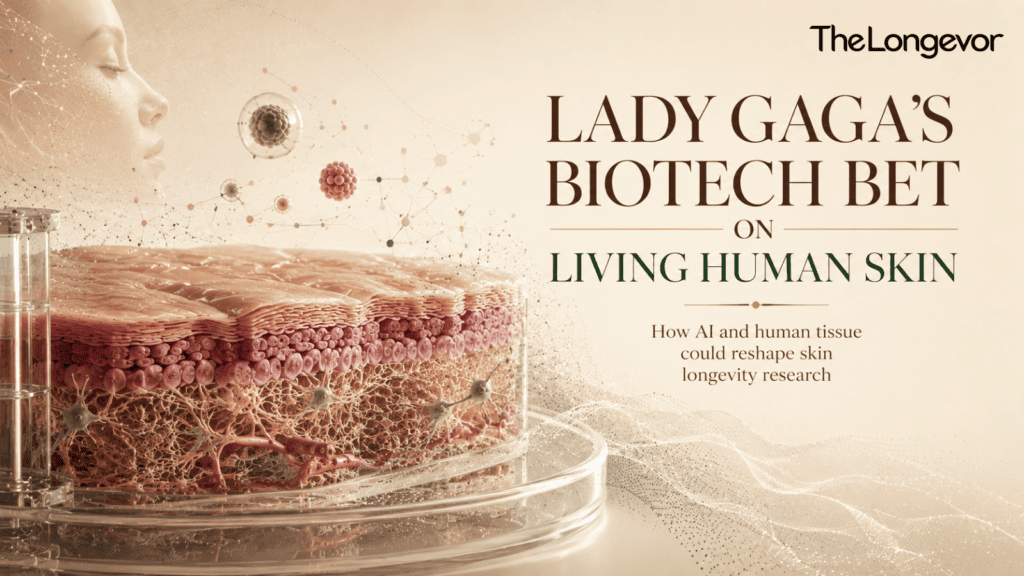
Could Lady Gaga’s New Biotech Venture Change Skin Longevity Research?
What happens when we stop asking Which skincare ingredient works? and start asking What is actually happening inside aging human skin?
That is the more interesting question behind Outer Bio, the skin-health discovery company co-founded by Lady Gaga and Michael Polansky.
On August 24, 2026, Outer Bio emerged from stealth with Yuna, an ex vivo platform designed to keep full-thickness human skin alive and measurable for four weeks or more. Gaga is publicly involved with the company as a co-founder and board member.
But is this simply another celebrity beauty venture?
Not quite.
The more important story is what Outer Bio is trying to do with living human skin and what that could mean for skin longevity research.
Why Is Skin Aging So Difficult to Study?
Could one of the biggest problems in skin-aging research simply be that researchers cannot watch the biology for long enough?
Processes such as collagen remodeling, chronic inflammation, cellular senescence and tissue repair unfold over time. Yet conventional ex vivo skin models typically provide a much shorter experimental window.
Outer Bio’s proposition is therefore straightforward:
What if human skin could remain experimentally usable long enough for these processes to unfold?
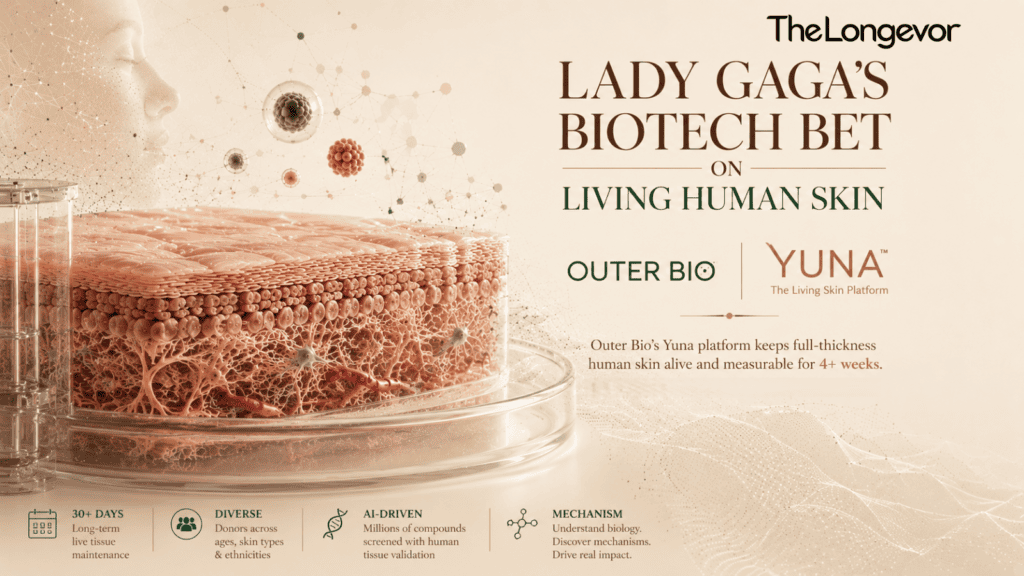
Yuna is designed around that idea. The company says it maintains full-thickness human skin including epidermis, dermis, resident cell populations and immune-associated molecular programs for 30 days or more.
Could Living Human Skin Be Better Than Another Cell Model?
Why study aging skin only through simplified systems when the tissue itself can potentially be studied?
Yuna uses full-thickness human tissue, with Outer Bio reporting donors across different ages, genders, racial backgrounds, body regions and Fitzpatrick skin types I–VI.
That matters because human skin is heterogeneous.
An intervention may behave differently across biological backgrounds. Instead of treating this variation purely as experimental noise, Yuna attempts to incorporate it into the discovery dataset.
Can Skin Longevity Research Finally Study Aging Over Time?
What could researchers learn if they could observe aging-associated biology for weeks instead of days?
Outer Bio describes Yuna for investigating skin aging, senescence, chronic inflammation, collagen and matrix remodeling, regeneration, barrier function and UV-induced damage.
Its recently released preprint reports sustained inflammatory responses, aging-associated changes in older donor tissue and UV-induced stress. The model also responded to known interventions, including a JAK inhibitor, a senolytic-associated treatment and sunscreen.
But there is an important caveat:
The study is a preprint and has not yet undergone peer review.
So the findings are intriguing but they are not proof that Yuna can predict successful anti-aging treatments in humans.
What Happens When AI Meets Human Skin?
Could the next skincare discovery come from an algorithm but be validated in actual human tissue?
That is where Yuna becomes more than a tissue model.
Outer Bio says its machine-learning system computationally screens compounds before promising candidates move through automated screening and human-tissue testing. The resulting biological data are then fed back into the models.
The intended loop is:
AI prediction → automated screening → human tissue → biological data → improved prediction.
Outer Bio reports screening capacity of approximately 750 million compounds annually and more than 30,000 data points per compound. These are company-reported capabilities, not independently validated outcomes.
Could This Move Skincare From Ingredients to Mechanisms?
What if the next generation of skincare begins not with an ingredient, but with a biological question?
Instead of asking:
Which ingredient should we add?
researchers could ask:
Which biological mechanism is driving this aspect of skin aging and can we change it?
Outer Bio says its platform aims to identify novel biological targets and then identify molecules capable of influencing them.
That approach moves skin research closer to mechanism-driven discovery.
Does Lady Gaga Make This More Important or Just More Visible?
Lady Gaga brings enormous visibility to the company.
But should celebrity involvement influence how we judge the science?
No.
Yuna still needs independent validation, peer-reviewed evidence and, ultimately, evidence that discoveries made in ex vivo tissue translate into meaningful outcomes in humans.
It has not demonstrated lifespan extension, systemic healthspan extension or clinical reversal of skin aging.
What it potentially offers is more fundamental:
a new way to study human skin biology over time.
Could Better Models Be the Future of Skin Longevity?
Perhaps the most important question is not whether Yuna discovers the next blockbuster skincare ingredient.
It is whether platforms like Yuna represent a new model for skin longevity research:
AI predicts. Human tissue tests. Multi-omics measures. Data teaches the next prediction.
If that loop proves reproducible, skin longevity research could move closer to mechanism-driven, human-relevant discovery.
And perhaps that is the real story behind Lady Gaga’s biotech venture.
Not another celebrity skincare launch.
But a much harder question:
Can we understand aging skin by watching human biology unfold rather than simply searching for ingredients that make it look younger?
For now, Yuna has raised the question.
The science will determine how far the answer goes.