
The Aging Cell’s Hidden DNA: Could LINE-1 Be Driving Inflammation?
As cells age, ancient genetic elements that are normally kept silent can become active again. New research suggests that one of them, LINE-1, may help fuel the chronic inflammation associated with aging — revealing a surprising connection between genome regulation, cellular senescence and inflammaging.
Aging is often described as a gradual accumulation of damage. DNA becomes less stable, mitochondria become less efficient, and cells lose their ability to maintain normal function.
But there is another change taking place inside aging cells: genetic elements that were supposed to remain silent can begin to switch back on.
One of the most important of these elements is LINE-1, short for Long Interspersed Nuclear Element-1.
LINE-1 sequences make up roughly 17% of the human genome. Most copies are inactive, but some retain the ability to produce RNA and proteins involved in their movement within the genome. Under normal conditions, cells use several layers of genetic and epigenetic control to keep LINE-1 activity suppressed.
As those protective systems weaken with age, LINE-1 can become derepressed.
And researchers are increasingly asking a provocative question: Could this ancient piece of our genome be helping drive the inflammation of aging?
What Is LINE-1?
LINE-1 is a type of retrotransposon — a genetic sequence capable of copying itself through an RNA intermediate.
Unlike a conventional gene, LINE-1 does not primarily exist to produce a protein required by the body. Instead, active LINE-1 elements can generate RNA and proteins, including ORF1p and ORF2p, that participate in the retrotransposition process.
The overwhelming majority of LINE-1 copies are inactive because cells have evolved powerful mechanisms to silence them. These include DNA methylation and modifications to histone proteins, which help keep potentially disruptive genomic sequences tightly controlled.
This suppression is important because uncontrolled LINE-1 activity can contribute to genomic instability.
But aging can disturb the epigenetic landscape that keeps LINE-1 quiet. When LINE-1 becomes active, the consequences may extend beyond the genome itself.
From Silent DNA to an Inflammatory Signal
One of the most interesting discoveries about LINE-1 is that its activity can activate the body’s innate immune defenses.
When LINE-1 is expressed and undergoes reverse transcription, it can generate nucleic-acid molecules in cellular compartments where they normally would not be present. The immune system can interpret these molecules as signals resembling those produced during infection.
This can activate pathways such as cGAS–STING, which normally help cells detect foreign or abnormal DNA. The result can be the production of inflammatory signals, including type-I interferons.
This creates a potentially important connection:
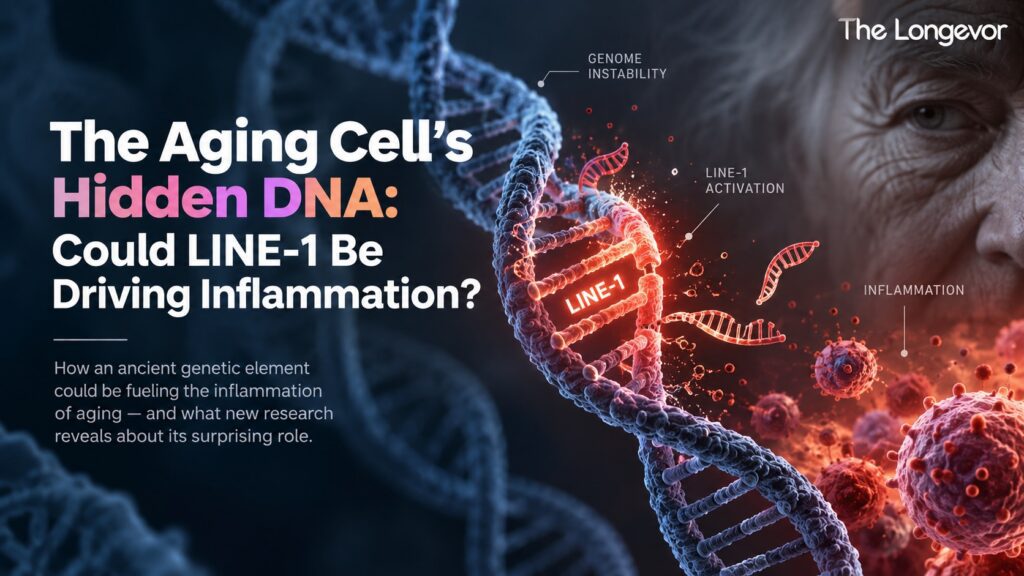
Aging → LINE-1 activation → abnormal nucleic-acid accumulation → innate immune sensing → inflammation.
Earlier research demonstrated that LINE-1 becomes transcriptionally derepressed in senescent cells and that LINE-1-derived cDNA can trigger an interferon response. In aged mice, inhibiting LINE-1 reverse transcriptase with lamivudine reduced inflammatory signaling in several tissues.
That work established the basic concept that LINE-1 is more than a passive piece of genomic DNA. It can become an active source of inflammatory signals.
New Research Adds an Unexpected Twist
Research published in Nature Aging in August 2026 has complicated the story further.
Scientists studying cGAS, a major DNA-sensing protein, found that removing cGAS unexpectedly caused increased LINE-1 activity, disruption of the histone mark H3K9me3, inflammation and accelerated aging-related phenotypes in mice.
At first glance, that seems contradictory.
cGAS is widely known for detecting DNA in the cytoplasm and activating inflammatory signaling through STING. If cGAS can promote inflammation, why would eliminating it make aging-related inflammation worse?
The new research suggests that cGAS has another role. It appears to help maintain the organization of H3K9me3, an epigenetic mark associated with tightly controlled, transcriptionally silent regions of the genome.
When cGAS was absent, this organization became disrupted. LINE-1 elements were subsequently derepressed, resulting in increased LINE-1-derived DNA in the cytoplasm and activation of inflammatory responses.
This suggests that cGAS may have a protective genome-maintenance function in addition to its well-known immune-sensing role.
Why H3K9me3 Matters
To understand why this matters, it helps to think of the genome as more than a sequence of DNA letters.
DNA is packaged around proteins called histones. Chemical modifications on these histones help determine which regions of DNA are accessible and which remain silent.
H3K9me3 is one of the modifications associated with compact, repressed chromatin.
For LINE-1, maintaining this repressed state is crucial. If the epigenetic “locks” surrounding these elements weaken, previously silent LINE-1 sequences can become transcriptionally active.
That means aging-related epigenetic deterioration could potentially have a second-order effect:
Loss of genomic repression → LINE-1 activation → innate immune sensing → chronic inflammation.
In this model, the problem is not necessarily a new mutation appearing in an aging cell. It is an old piece of DNA becoming inappropriately active.
LINE-1 May Also Affect the Heart
The connection is not limited to general cellular aging.
A Nature Aging study published in 2026 found that LINE-1 expression increased in aging mouse hearts. When researchers disrupted MOV10, a protein involved in suppressing LINE-1 activity, mice developed premature cardiac aging, cardiac dysfunction and activation of the cGAS–STING pathway.
Researchers then tested inhibitors targeting LINE-1 reverse transcription and STING signaling.
In aged mice, these interventions reduced inflammatory and senescence-related phenotypes and improved measures of cardiac function.
These findings are intriguing because they suggest that LINE-1 may not simply be a marker of aging. In some tissues, it may actively contribute to the processes that cause age-related dysfunction.
However, these experiments were primarily performed in mice and cells. That distinction matters.
Could LINE-1 Be a Therapeutic Target?
Potentially — but it is far too early to call LINE-1 inhibition an anti-aging treatment.
Researchers are investigating whether drugs that inhibit LINE-1 reverse transcriptase could reduce age-associated inflammation. Existing nucleoside reverse-transcriptase inhibitors have already been used experimentally to suppress LINE-1 activity.
Earlier mouse studies found that drugs such as lamivudine could reduce inflammatory signaling associated with LINE-1 activation.
But an important question remains:
Would long-term LINE-1 inhibition be safe and beneficial in humans?
LINE-1 is not simply useless genetic debris. Retrotransposons have played evolutionary roles in genome structure and regulation, and some transposable-element activity occurs normally.
Completely suppressing their activity throughout the body could therefore have consequences researchers do not yet fully understand.
The Human Question
One of the biggest limitations of current LINE-1 aging research is the gap between mechanistic evidence and clinical evidence.
Scientists have strong evidence from cellular and animal models that LINE-1 activation can contribute to inflammatory signaling. There is also growing evidence connecting LINE-1 activity with human aging and age-related disease.
But we do not yet have clinical evidence showing that suppressing LINE-1 in healthy older people will extend lifespan, prevent dementia or reverse biological aging.
That distinction is essential.
The discovery is exciting because it identifies a potentially targetable mechanism — not because an anti-aging therapy already exists.
The Bigger Picture
The LINE-1 story changes the way we can think about the aging genome.
Aging may not simply mean that DNA accumulates damage. It may also mean that the systems responsible for keeping potentially disruptive DNA sequences silent gradually lose control.
Once that control weakens, LINE-1 can become active. The cell may then interpret the resulting genetic material as a danger signal, activating inflammatory pathways that are normally designed to protect us from infection.
Over time, that response could contribute to inflammaging — the persistent, low-level inflammatory state associated with aging.
The emerging model looks something like this:
- Epigenetic aging
- Loss of LINE-1 repression
- LINE-1 RNA/cDNA accumulation
- cGAS–STING and other immune-sensing pathways
- Chronic inflammatory signaling
- Cellular and tissue dysfunction
That does not mean LINE-1 is the single cause of aging. Aging is far too complex for one pathway to explain it.
But LINE-1 may represent one important link between genome regulation and inflammation.
The Longevor Takeaway
LINE-1 was once viewed largely as genomic baggage — ancient genetic material that the body spends considerable effort keeping silent.
New research suggests it may be much more consequential.
When aging disrupts the epigenetic mechanisms that normally suppress LINE-1, these elements can become active and generate molecular signals capable of triggering inflammatory pathways. Recent studies have connected LINE-1 activation with cellular senescence, cardiac aging and inflammaging, while new 2026 research suggests that maintaining LINE-1 repression may itself be part of the body’s defense against age-related inflammation.
The major unanswered question is whether this mechanism can be safely targeted in humans.
For now, LINE-1 is not an established anti-aging treatment target.
But it offers a fascinating possibility:
Some of the inflammation associated with aging may be coming not from an outside infection, but from our own ancient genetic elements becoming active again.
And understanding why those elements escape cellular control could reveal another piece of the biological puzzle of aging.