
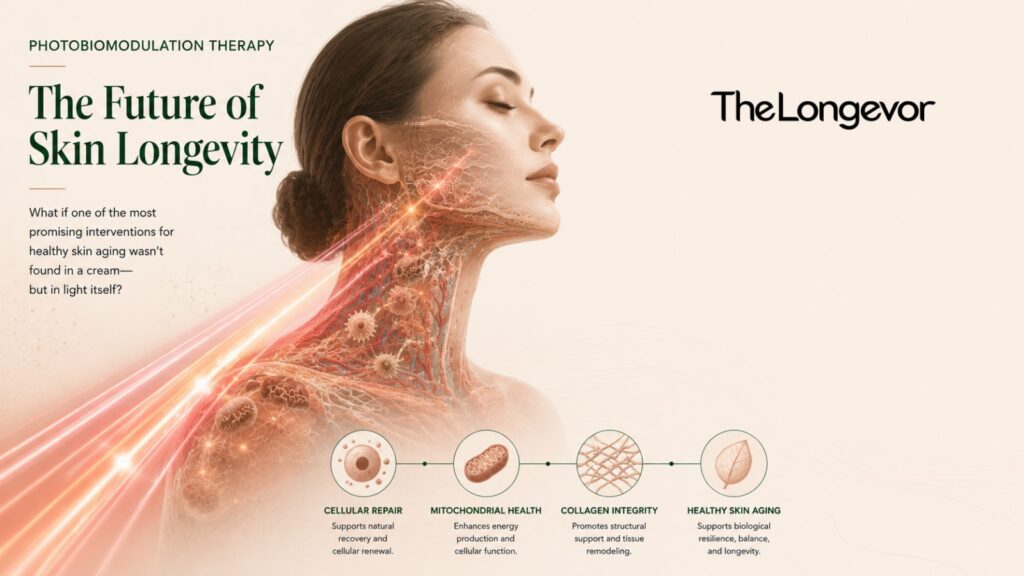
The Future of Skin Longevity: Can Light Help Us Age Better?
Your skin is rebuilding itself right now. Millions of cells are being repaired. Collagen fibers are being remodeled. Immune cells are regulating inflammation while mitochondria quietly produce the energy required to maintain one of the body’s most remarkable organs. Most of this happens without us ever noticing.
Until it doesn’t. As we age, our skin gradually loses some of its remarkable capacity for repair and resilience. Collagen production slows. Chronic low-grade inflammation becomes increasingly persistent. Cellular repair pathways become less efficient, while environmental stressors silently accumulate across decades.
The visible signs of skin aging are simply the final chapter of a much larger biological story. For decades, we have approached this story almost exclusively through cosmetics. We have asked how we can look younger rather than how we can help our skin remain biologically healthier for longer. Longevity science is beginning to ask a different question.
What if healthy skin isn’t defined by how young it looks—but by how well it functions throughout life?
That question is helping shape the emerging field of skin longevity, where researchers are increasingly exploring interventions that may support cellular resilience rather than merely masking the visible signs of aging.
Among the most fascinating is Photobiomodulation Therapy (PBM)—a therapeutic approach that uses specific wavelengths of red and near-infrared light to influence biological processes involved in tissue repair, inflammation, mitochondrial function, and skin regeneration.
Once investigated primarily for wound healing and pain management, photobiomodulation therapy is now attracting growing attention within regenerative medicine and longevity science.
Could light help our skin age better? The science is still evolving. But it may already be illuminating what the future of healthy skin aging could look like. Then I would change the entire flow of the article.
Why Does Our Skin Age?
- Hallmarks of Aging
- Mitochondrial dysfunction
- inflammaging
- cellular senescence
- collagen decline
- microbiome alterations.
What Is Photobiomodulation Therapy?
Explain:
- red light
- near infrared
- FDA-approved indications
- PBM history.
When Light Meets Biology
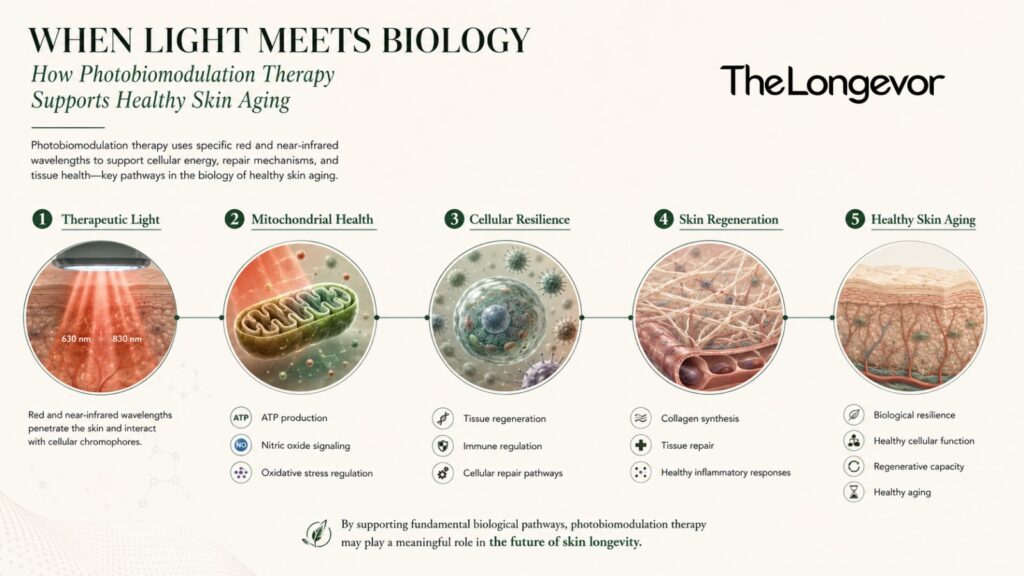
This is where we tell the story. Light enters biological tissues. Mitochondria respond. Cellular energy production changes. Repair pathways are activated. Inflammatory signaling is modulated. Tissue regeneration begins.
Then beautifully explain:
- ATP
- Cytochrome c oxidase
- ROS signaling
- Nitric oxide
- collagen synthesis.
Could Photobiomodulation Therapy Support Healthy Skin Aging?
Discuss:
- wrinkles
- elasticity
- inflammation
- wound healing
- collagen
- psoriasis
- acne
- scars.
What Does Current Human Research Tell Us?
The growing interest surrounding photobiomodulation therapy is supported by an expanding body of clinical research. Human studies have reported improvements in skin elasticity, collagen density, wound healing, and inflammatory skin conditions following carefully designed photobiomodulation interventions. However, the science remains far from settled.
Then discuss:
- limitations
- small sample sizes
- protocols
- future trials.
Beyond Skin Aging: Why Longevity Medicine Is Paying Attention
This is where The Longevor becomes different. Discuss:
- HBOT
- PBM
- peptides
- exosomes
- AI
- regenerative medicine
- precision longevity.
Aging does not occur one organ at a time. Neither will longevity medicine. Researchers increasingly understand aging as the gradual decline of interconnected biological systems. Skin is no exception.
Interventions capable of influencing mitochondrial function, inflammation, tissue repair, and cellular resilience are attracting growing attention precisely because they may affect multiple aspects of healthy aging simultaneously. Photobiomodulation therapy represents one piece of a much larger story.
The Future of Skin Longevity May Be Written in Light
Don’t end like other publications. End like this: There was a time when regenerative medicine sounded like science fiction. There was a time when artificial intelligence seemed decades away from transforming healthcare. Today, longevity science finds itself at a similar moment filled with promising questions and incomplete answers. Photobiomodulation therapy is unlikely to become a miracle cure for aging. Biology is rarely that simple.
But perhaps that was never the most interesting question. The more fascinating possibility is this: What if the future of healthy skin aging isn’t about reversing time but preserving our biology’s remarkable ability to repair itself?
The goal may never have been to stop our skin from aging. It may simply be to help it remain resilient for as long as possible. And maybe the future of skin longevity won’t begin with asking how old we are. It will begin by asking how healthy our skin can remain across an entire lifetime.