
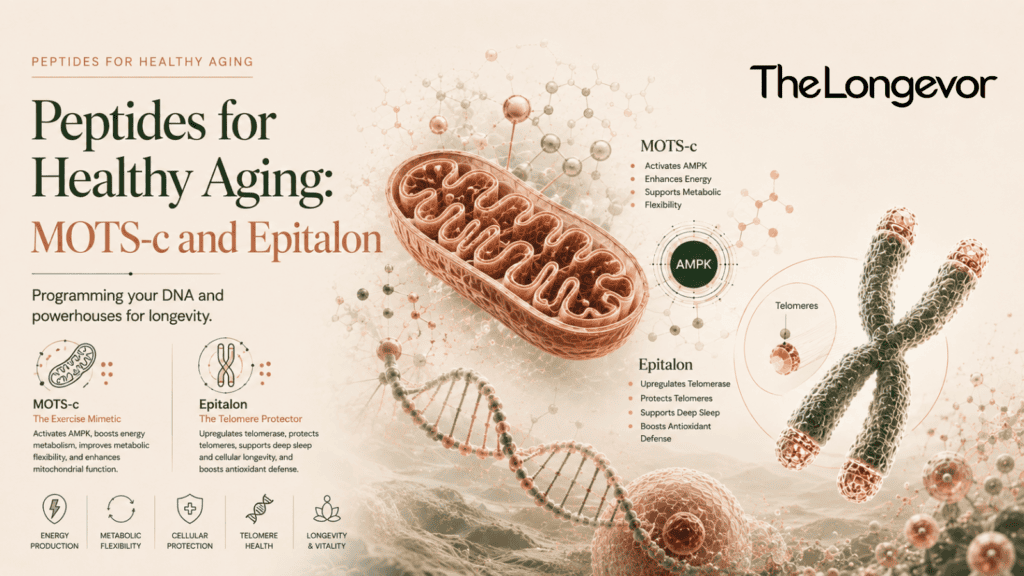
Peptides for Healthy Aging: MOTS-c and Epitalon
Why Peptides Matter for Cellular Longevity
If you’ve been following this peptides series, you’ll notice we’ve been working from the outside in.
We started with metabolism how the body produces and uses energy. Then we explored peptides that help maintain muscles, joints, and connective tissues. Those systems matter because they’re what we experience every day: strength, mobility, recovery, and resilience.
But aging doesn’t begin in our joints or muscles.
It begins inside the trillions of cells that quietly keep us alive.
Every wrinkle, slower recovery, declining energy level, or loss of metabolic flexibility can ultimately be traced back to tiny biological processes taking place deep within individual cells. That’s why many longevity researchers believe the next chapter of anti-aging medicine won’t be written at the organ level it will be written at the cellular level.
Among the most talked-about compounds in this space are two peptides with very different jobs: MOTS-c, which is being investigated for its effects on mitochondrial metabolism, and Epitalon, which has attracted attention for its possible relationship with telomere biology.
Rather than masking the symptoms of aging, both are being studied for their potential to influence some of the biological mechanisms that drive aging itself.
MOTS-c: A Peptide That Speaks the Language of Energy
Almost everyone remembers learning that mitochondria are the “powerhouses of the cell.”
It sounds like a cliché, but it’s still one of the best descriptions we have.
Mitochondria convert nutrients and oxygen into ATP the molecular fuel that powers virtually every process in the body, from muscle contraction to brain function. Every heartbeat, every memory, every step you take depends on healthy mitochondrial function.
The problem is that mitochondria don’t remain perfectly efficient forever.
As we age, they gradually produce less energy while generating more reactive oxygen species, contributing to oxidative stress and declining cellular performance. Researchers now consider mitochondrial dysfunction one of the defining features of biological aging.
This is where MOTS-c becomes particularly interesting.
Unlike most peptides, MOTS-c isn’t encoded in the DNA stored inside the cell nucleus. Instead, it’s produced from mitochondrial DNA itself a discovery that challenged long-held assumptions about how mitochondria communicate with the rest of the body.
How MOTS-c Works
Scientists often describe MOTS-c as an exercise mimetic, although that term can be misleading if taken literally.
It doesn’t replace physical activity, nor does it reproduce all of exercise’s benefits. Instead, laboratory research suggests that MOTS-c can activate several of the same metabolic pathways that become active during exercise, particularly those involved in energy sensing.
One of its best-known targets is AMPK, sometimes called the cell’s metabolic master switch. When activated, AMPK encourages cells to produce energy more efficiently while improving the way glucose and fats are used.
Early research suggests MOTS-c may help support:
- Better metabolic flexibility
- Improved insulin sensitivity
- Activation of AMPK signaling
- More efficient cellular energy production
- Healthier mitochondrial function
Much of this work remains preclinical, but the findings have made MOTS-c one of the most closely watched peptides in longevity research.
Why Longevity Researchers Are Paying Attention
One of the biggest challenges of aging is maintaining energy production.
As mitochondrial performance declines, many tissues including skeletal muscle, the brain, and the cardiovascular system become less efficient. That gradual loss of cellular energy is thought to contribute to fatigue, metabolic dysfunction, and reduced physical performance.
Researchers are exploring whether supporting mitochondrial signaling could help slow some of these age-related changes.
While it’s still too early to draw firm clinical conclusions, MOTS-c represents an intriguing example of therapies designed to improve cellular function rather than simply treating disease after it appears.
Epitalon: Looking After the Ends of Our DNA
If MOTS-c is about keeping the cell’s power supply running efficiently, Epitalon turns attention to another hallmark of aging: the gradual shortening of telomeres.
Inside every cell, our DNA is packaged into chromosomes. At the very ends of those chromosomes sit telomeres protective sequences that act much like the plastic caps on the ends of shoelaces.
Each time a cell divides, those protective caps become slightly shorter.
Eventually, telomeres reach a critical length where cells can no longer divide normally. Many enter a state known as cellular senescence, while others undergo programmed cell death. Over time, this accumulation of aging cells is thought to contribute to tissue dysfunction and age-related disease.
How Epitalon Works
Epitalon is a synthetic peptide composed of just four amino acids and was originally developed at the St. Petersburg Institute of Bioregulation and Gerontology.
Its greatest scientific interest comes from studies suggesting it may stimulate telomerase, the enzyme responsible for maintaining telomere length.
Because telomerase activity naturally declines in most adult tissues, researchers have long wondered whether carefully regulating this enzyme could help preserve cellular function during aging.
This remains an active area of investigation, and while encouraging laboratory findings exist, robust clinical evidence in humans is still limited.
Potential Areas of Interest: Epitalon
Current research suggests Epitalon may have the potential to support:
- Healthy cellular renewal
- Maintenance of telomere biology
- Melatonin regulation
- Sleep quality
- Antioxidant defense systems
Many of these findings come from experimental or early-stage studies, meaning further research will be needed before any definitive conclusions can be made.
Why Mitochondria and Telomeres Matter Together
Although MOTS-c and Epitalon work through different biological pathways, they share a common goal.
Healthy aging depends on cells that can both produce energy efficiently and maintain their genetic stability.
Mitochondria keep those cells functioning.
Telomeres help determine how long they remain capable of dividing and repairing tissues.
When either system begins to fail, the effects ripple across the body from reduced muscle strength and slower recovery to impaired metabolism and declining organ function.
It’s no surprise, then, that both mitochondrial biology and telomere maintenance have become major areas of longevity research over the past decade.
Looking Ahead
The next generation of longevity therapies is increasingly focused on the biology that sits beneath disease rather than the diseases themselves.
Instead of asking how to treat arthritis, diabetes, or frailty after they develop, researchers are beginning to ask a different question:
Can we preserve the health of the cells before those conditions emerge?
MOTS-c and Epitalon are part of that broader scientific shift. One explores ways to improve mitochondrial communication and energy metabolism, while the other investigates how cells maintain the integrity of their DNA over time.
Neither should be viewed as a proven anti-aging therapy today, but both illustrate how rapidly longevity science is moving toward interventions that target the fundamental biology of aging.
Final Thoughts
The story of aging is increasingly becoming the story of our cells.
While muscles, skin, and organs are where we notice the effects, the underlying changes often begin much earlier inside mitochondria, chromosomes, and the intricate molecular networks that keep cells functioning.
MOTS-c and Epitalon have generated considerable interest because they address two of these fundamental systems. Whether they ultimately become mainstream longevity interventions remains to be seen, but they have already helped reshape how scientists think about healthy aging.
The future of longevity medicine may not simply be about living longer. It may be about preserving the health and performance of our cells long before age-related decline becomes visible.