

DNA Methylation Clock: New Clues from Progeria
For more than a decade, DNA methylation clocks have been among the most influential tools in aging research. By measuring chemical modifications attached to DNA, these clocks can estimate biological age with remarkable accuracy. Yet a fundamental question has remained unresolved: do these epigenetic changes merely track aging, or do they actively contribute to it?
A new study published in Nature Genetics offers one of the clearest pieces of evidence yet that the answer may be more complicated than many researchers assumed. By examining a rare accelerated-aging disorder driven by abnormal DNA methylation, scientists have uncovered a direct connection between age-associated epigenetic alterations, stem-cell dysfunction, and tissue decline.
The findings do not prove that epigenetic clocks cause normal aging. However, they provide a compelling biological link between age-related methylation changes and the deterioration of tissues that characterizes growing older.
What Happened?
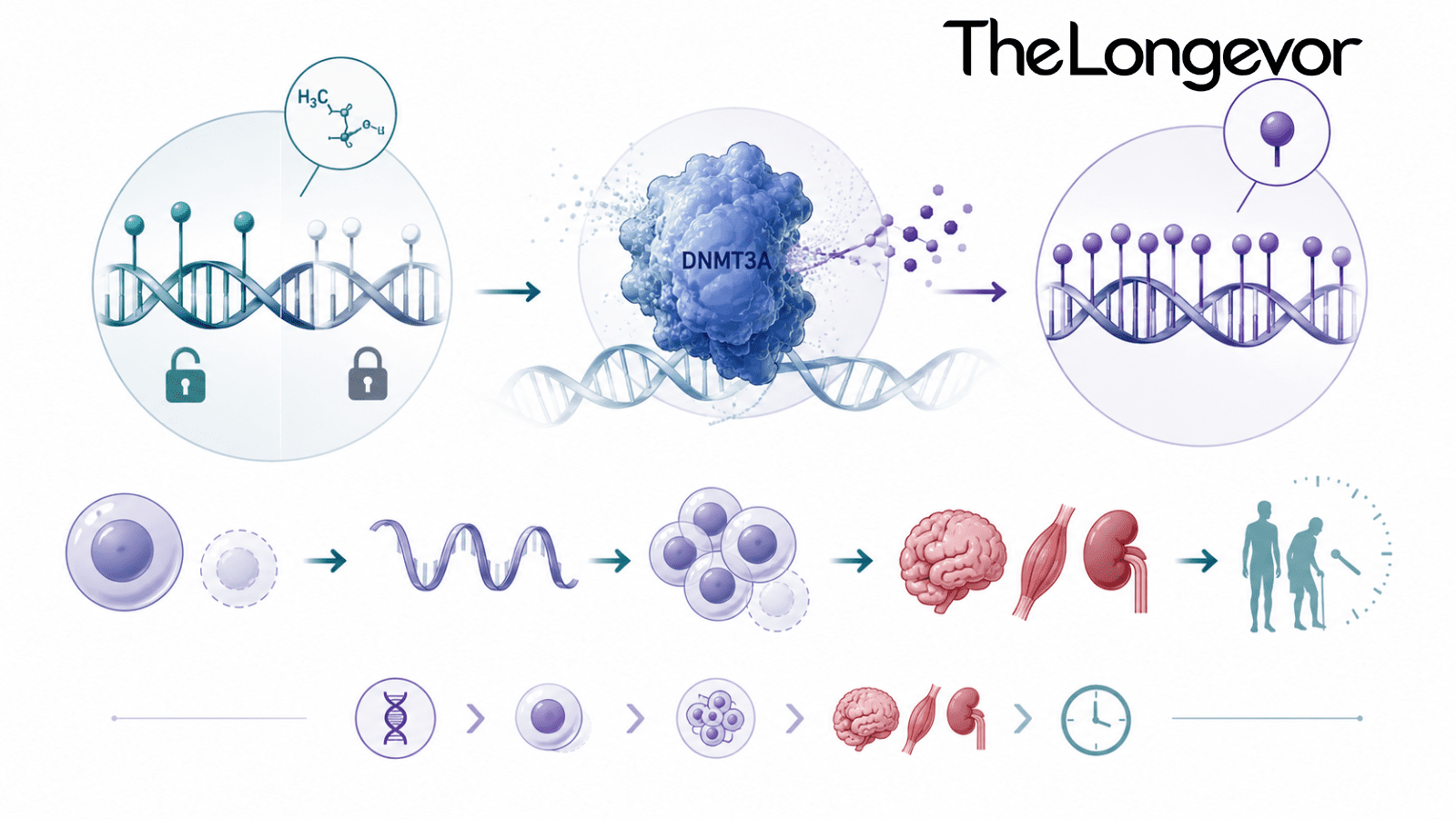
Researchers investigated a rare progeria syndrome caused by gain-of-function mutations in DNMT3A, a gene encoding an enzyme responsible for adding methyl groups to DNA.
DNA methylation is an epigenetic process that regulates gene activity without altering the underlying genetic sequence. Across the lifespan, predictable methylation changes accumulate throughout the genome. These patterns form the basis of biological age clocks used in both research and increasingly in commercial longevity testing.
The study found that excessive DNMT3A activity produced widespread DNA hypermethylation resembling age-associated epigenetic changes. Importantly, these alterations were linked to impaired adult stem-cell function and progressive tissue dysfunction.
Rather than simply observing accelerated aging-like symptoms, investigators identified mechanistic connections between abnormal methylation patterns and biological processes necessary for tissue maintenance.
The work therefore provides evidence that at least some age-related methylation changes may have functional consequences rather than serving solely as passive biomarkers.
The highest level of evidence remains mechanistic human genetic evidence combined with cellular and molecular investigations. The study does not demonstrate effects in the general aging population but offers a powerful natural experiment.
The Science Behind It
DNA methylation involves the attachment of methyl groups to specific DNA regions. These modifications influence which genes are active and which remain silent.
One of the most striking discoveries in biogerontology has been that methylation patterns change predictably with age. These changes are so consistent that researchers can estimate biological age using only DNA methylation data.
The challenge has been interpretation.
Many scientists viewed epigenetic clocks primarily as readouts of aging—a molecular speedometer rather than an engine. Others proposed that age-related methylation changes might actively contribute to tissue dysfunction.
This study strengthens the second possibility.
The key player is DNMT3A, an enzyme that establishes DNA methylation marks. When DNMT3A becomes excessively active, methylation accumulates in genomic regions that appear vulnerable during aging.
The consequences extend beyond molecular measurements. Adult stem cells, responsible for tissue maintenance and repair, showed impaired function.
Stem-cell exhaustion is one of the recognized hallmarks of aging. As stem-cell populations lose regenerative capacity, tissues become less capable of repairing damage, contributing to declines in organ function.
The findings also intersect with another hallmark: epigenetic alterations. These refer to age-related changes in gene regulation that occur independently of DNA sequence mutations.
The study therefore connects two major aging hallmarks through a plausible mechanistic pathway:
Epigenetic dysregulation → altered gene expression → stem-cell dysfunction → tissue decline.
This chain of events provides a biological explanation for how methylation changes might contribute to aging-related pathology.
Importantly, the results do not imply that all methylation changes are harmful. Some may represent adaptive responses. Aging likely reflects a complex mixture of beneficial, neutral, and detrimental epigenetic modifications.
How Strong Is the Evidence?
The evidence should be considered early translational and mechanistic.
Strengths include:
- Identification of a defined genetic driver
- Direct links between hypermethylation and cellular dysfunction
- Mechanistic insights into stem-cell impairment
- Publication in a high-impact genetics journal
Limitations include:
- Study of a rare syndrome rather than normal aging
- Uncertainty regarding generalizability
- Lack of direct intervention demonstrating reversibility
The findings support mechanistic insight and suggest causation within the disease model. They do not establish that epigenetic clock changes broadly cause aging in healthy individuals.
Why It Matters for Longevity
Biological age measurement has become one of the fastest-growing areas in longevity science. Investors, biotechnology companies, clinicians, and consumers increasingly rely on methylation clocks to evaluate interventions and track aging trajectories.
If methylation patterns are merely biomarkers, modifying them may offer limited benefit. If they participate directly in aging biology, however, they become potential therapeutic targets.
This distinction has enormous implications.
The study suggests that at least some age-associated methylation changes may contribute to tissue deterioration through effects on stem-cell function. That possibility strengthens interest in epigenetic reprogramming approaches, regenerative medicine strategies, and therapies aimed at restoring youthful gene-expression patterns.
The work also highlights the value of rare genetic disorders as windows into normal aging mechanisms. Just as familial cholesterol disorders transformed cardiovascular research, progeria syndromes may reveal causal pathways underlying biological aging.
Most importantly, the findings move the field beyond correlation. They begin to address whether molecular aging clocks reflect deeper biological processes that actively shape healthspan.
What We Still Don’t Know
Several important questions remain unanswered.
Researchers do not yet know whether the same mechanisms operate during ordinary human aging.
It remains unclear which methylation changes are causal, which are compensatory, and which are biologically irrelevant.
The study also does not establish whether reversing hypermethylation can restore stem-cell function or improve tissue health.
Future research will need to demonstrate:
- Reversibility of dysfunction
- Similar mechanisms in normal aging
- Tissue-specific effects
- Long-term safety of epigenetic interventions
These questions will determine whether epigenetic clock biology becomes primarily a diagnostic tool or a therapeutic target.
Future Outlook
Over the next five years, researchers are likely to intensify efforts to identify methylation changes with direct biological consequences.
Within a decade, more sophisticated epigenetic interventions could emerge that selectively modify age-associated regulatory programs.
Looking twenty years ahead, the field may move toward precision epigenetic medicine, where biological age measurements guide targeted interventions.
Whether such approaches can safely alter aging trajectories remains one of the defining scientific questions of modern geroscience.
Conclusion
DNA methylation clocks transformed how researchers measure aging. This new progeria study tackles a deeper question: what exactly are those clocks measuring?
While the findings do not settle the debate, they provide some of the strongest evidence yet that age-associated epigenetic changes may be more than molecular timestamps. They may represent part of the biological machinery through which aging unfolds.