
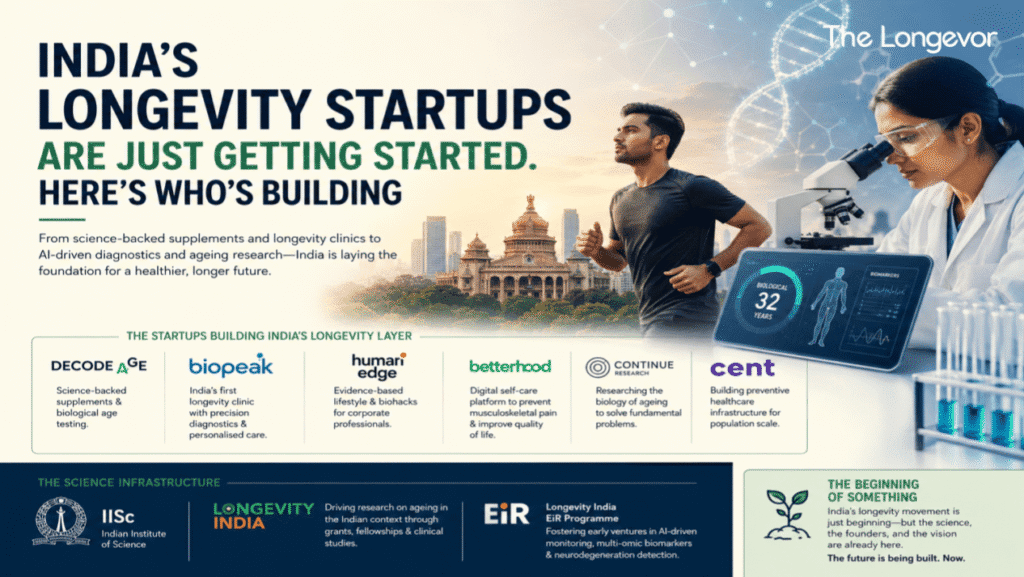
India’s Longevity Startups Are Just Getting Started: Here’s Who’s Building
While the global longevity market is raking in billions, India’s longevity ecosystem is playing a completely different game. It is early, heavily underfunded compared to the sheer scale of the problem, and yet—it is officially in motion.
Surprisingly, Bangalore already ranks among the top five global longevity startup hubs alongside heavyweights like London, New York, San Francisco, and Dubai. This isn’t an accident. India has the raw scientific talent, a massive population, and an urgent demographic need. What it lacked until recently was a group of founders willing to plant a flag.
That script is being rewritten right now.
Why India Needs This More Than Most
India isn’t looking at a longevity crisis decades down the road; it’s happening right now in slow motion. The country is seeing an unprecedented wave of citizens entering their 40s and 50s—the exact decades where metabolic issues, heart risks, and cognitive decline start to snowball.
- The Reality Check: Type 2 diabetes already affects over 100 million Indians, and cardiovascular disease remains the leading cause of death.
- The System Deficit: India’s healthcare system is structurally built around reactive care treating people after they get sick rather than preventing the crash.
The gap between cutting-edge global science and ordinary clinical practice in India is massive. But that gap is exactly where the opportunity lies.
The Startups Building India’s Longevity Layer
A handful of pioneering companies are shifting the focus from general “wellness” to deep, data-driven longevity science.
Advanced Diagnostics & Therapeutics
- Decode Age (Bengaluru): Currently the most funded pure-play longevity startup in India, they recently locked in an INR 14.48 crore Pre-Series A round led by Dr. Krishna Prasad Chigurupati (MD of Granules India). They are using this capital to scale research infrastructure and bring advanced biological age testing and science-backed supplements directly to Indian consumers.
- Biopeak (Bengaluru): This startup launched India’s first dedicated longevity clinic with a $3.5 million backing from major investors, including Nikhil Kamath (Zerodha) and the Manipal Group. Their flagship 3-to-6-month program starts with an exhaustive baseline: 130+ biomarker panels, DNA profiling, gut microbiome mapping, and VO₂ max tests. An AI-driven diagnosis is then handed over to a dedicated team of doctors and systems biologists to personalize the patient’s healthspan.
Lifestyle & Structural Interventions
- Human Edge (Mumbai): Targeting the high-stress corporate world, they raised over $1.5 million (led by Bharat Innovation Fund) to scale an enterprise mobile app that delivers daily, evidence-based lifestyle “biohacks” rooted in metabolic science.
- Betterhood: Focusing heavily on quality of life, this digital self-care platform targets chronic musculoskeletal pain—helping users identify root causes like poor posture or nutrition gaps to ensure their bodies actually move well as they age.
Moonshots & Infrastructure
- Continue Research: Founded by Zomato’s Deepinder Goyal, this venture bypasses consumer wellness to look directly at the biology of aging through its “Gravity Ageing” hypothesis.
- Cent: Launched by Practo’s founder, Shashank ND, Cent is quietly building the underlying preventive clinic and diagnostic infrastructure that population-scale longevity medicine will require to function.
The Research Foundation: IISc & Longevity India
Startups need deep science to survive, and India’s premier academic institutions are stepping up to build that foundation.
[IISc + Rainmatter] ➔ Longevity India Initiative ➔ BHARAT Study (Indian-specific Multi-Omics Data)
Historically, almost all longevity data has been gathered from Western demographics. But biological markers, diet patterns, and genetic risks don’t always translate seamlessly across borders. To fix this, Longevity India (based at the Indian Institute of Science) has launched the BHARAT study. This initiative uses a multi-omics approach to map out the specific biological signatures of healthy aging specifically for Indian populations.
Furthermore, their joint Entrepreneur-in-Residence (EiR) Programme with Zerodha’s Rainmatter fund is already spinning out early deep-tech ventures, including:
- AI-driven, smartphone-based cardiovascular monitoring for aging populations.
- Multi-omic biomarker panels designed to catch neurodegenerative diseases like Alzheimer’s years before symptoms appear.
The Honest Gaps
To take this space seriously, we have to acknowledge where it falls short. On a global scale, India’s longevity funding is still a drop in the bucket—the entire Asia-Pacific region accounted for just 1.1% of global longevity capital over the last year.
Furthermore, specialized clinical trial infrastructure is practically non-existent, regulatory frameworks for biological age testing are still opaque, and the general public (and even many doctors) still confuse longevity medicine with standard vitamin regimens or fitness trends.
The Ground Floor
What we are seeing today in India isn’t a fully matured ecosystem yet it’s the critical foundation for one. It took the West nearly a decade for longevity to move from the scientific fringe into mainstream boardrooms. India is embarking on that exact same trajectory, but with a massive advantage: local founders can learn from global mistakes while building tailored solutions for a unique population.
The builders stepping into the arena today aren’t late to the party. They are the ones turning on the lights.