
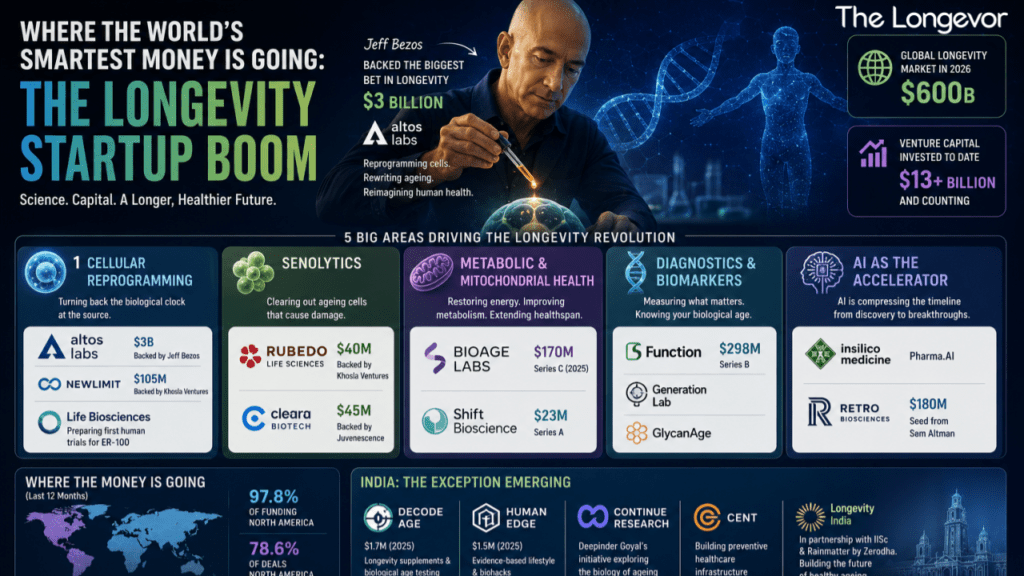
Where the World’s Smartest Money Is Going: The Longevity Startup Boom
Something massive is happening right at the intersection of biology, technology, and big capital.
Longevity science has officially broken out of quiet academic labs and philosophical debates to become one of the most heavily funded frontiers in modern medicine. We aren’t talking about wellness trends, clean eating, or anti-aging skincare here. This is a hardcore scientific mission to figure out exactly why our bodies deteriorate—and how to stop it before it starts.
With the global longevity market projected at $600 billion this year, and over $13 billion in venture capital already deployed, the world’s sharpest investors and most successful founders are placing massive, long-term bets on extending the human “healthspan.”
Here is a look at who is building this future, where the money is flowing, and how the landscape is shaping up.
The Heavy Hitters: Cellular Reprogramming
The single largest investment in longevity history belongs to Altos Labs, fueled by a massive $3 billion round backed by Jeff Bezos. Their work centers on “Yamanaka factors”—special proteins that can essentially rewrite mature cells back into a youthful state, erasing the molecular wear and tear of aging. Altos has already transitioned from pure theory into human clinical trials targeting neurodegenerative and immune-related aging disorders.
They aren’t alone in this territory:
- NewLimit: Backed by Khosla Ventures with a $105 million Series A, they are using epigenetic reprogramming to restore youthful gene expression.
- Life Biosciences: Co-founded by Harvard researcher David Sinclair, they are gearing up for the first-ever human trials of their partial reprogramming therapy (ER-100) to treat optic nerve damage and metabolic liver disease.
The Big Takeaway: Aging isn’t just random wear and tear. It’s a loss of cellular identity—and scientists are proving that identity can be restored.
Taking Out the Cellular Trash: Senolytics
As we age, some cells stop dividing but refuse to die. These are known as “senescent cells” (or “zombie cells”). They linger in our tissues, pumping out toxic inflammatory signals that damage surrounding healthy cells and accelerate systemic decline.
The goal of senolytics is simple: hunt down and selectively clear these zombie cells so tissues can heal and function normally.
- Rubedo Life Sciences secured a $40 million Series A (backed by Khosla Ventures) to build targeted senolytic therapies.
- Cleara Biotech brought in $45 million from精Juvenescence to advance its own cell-clearing programs.
While clinical evidence is still building, the investment signal is loud and clear: clean out the cellular debris, and the body bounces back.
The Fuel Engine: Metabolic & Mitochondrial Health
While some startups hunt for genetic fountains of youth, others are focusing on the biological machinery we use every single day: our metabolism and mitochondria (the powerhouses of our cells). When our cellular energy machinery degrades, it drives the fatigue, cognitive decline, and metabolic dysfunction we associate with getting older.
- BioAge Labs raised a $170 million Series C to develop therapeutics that target age-related metabolic decline.
- Shift Bioscience closed a $23 million Series A focused entirely on direct mitochondrial restoration.
What makes this sector so exciting is how close it is to real-world application. The biological targets are well understood, the biomarkers are easily measurable, and the potential patient population includes practically everyone.
You Can’t Manage What You Don’t Measure: Diagnostics
Chronological age is a terrible metric. Two people can both be 45 on paper, but decades apart in terms of cellular and cardiovascular health. Because of this, a massive diagnostics revolution is underway to track our actual biological age.
| Startup | Funding / Focus | What They Do |
| Function Health | $298M Series B (Largest private longevity round) | A consumer-scale preventive testing platform giving individuals deep visibility into their biomarkers. |
| Generation Lab | Epigenetic Healthspan Testing | Uses DNA methylation patterns to measure biological age with clinical precision. |
| GlycanAge | Glycan Biomarkers | Measures immune and metabolic age to track how systems are responding to interventions. |
The ultimate goal here is continuous, longitudinal monitoring—moving away from a single annual checkup toward a living, breathing picture of how your body is aging in real time.
AI as the Ultimate Accelerator
Cracking the code on aging is incredibly complex. The sheer volume of biological variables and the massive length of human lifespans make traditional drug discovery painfully slow and expensive. Artificial intelligence is changing the math.
- Insilico Medicine built Pharma.AI, an AI platform to discover novel drug candidates for age-related conditions like idiopathic pulmonary fibrosis.
- Retro Biosciences—launched with $180 million from Sam Altman—is applying massive computational power to master cellular autophagy (how cells clean themselves) and reprogramming.
AI doesn’t replace the underlying biology, but it compresses decades of traditional lab guesswork into a matter of months.
Emerging Frontiers: India’s Longevity Ecosystem
Right now, the capital concentration in this space is heavily lopsided—North America commands nearly 98% of all disclosed funding. However, India is beginning to emerge as a critical player, driven by a massive population entering the age brackets where metabolic and chronic diseases hit the hardest.
The ecosystem is growing fast:
- Decode Age raised $1.7 million to scale science-backed longevity supplements and biological age testing.
- Human Edge (Mumbai-based) secured $1.5 million to build a platform centered on evidence-based lifestyle biohacks grounded in metabolic science.
- Continue Research (backed by Deepinder Goyal) is diving into the biology of aging via its Gravity Ageing hypothesis, while Shashank ND’s Cent is working on fundamental preventive healthcare infrastructure.
- Longevity India Initiative (a partnership featuring IISc and Zerodha’s Rainmatter) launched a first-of-its-kind Entrepreneur-in-Residence program to build deep-tech solutions for healthy aging right in India.
The gap between cutting-edge global science and everyday clinical practice in India is wide, but that exact gap represents a massive opportunity for local innovation.
The Shift in Perspective
The longevity boom isn’t just one single trend or magic pill. It is the convergence of cellular reprogramming, senolytics, metabolic medicine, advanced diagnostics, and AI.
The money is serious, the science is rigorous, and the founders moving into this space are proven builders who view aging not as an inevitable law of nature, but as a complex medical condition that can be treated.
We are living through a fundamental shift in human history: the moment we stopped just trying to live longer, and started learning how to stay young.