
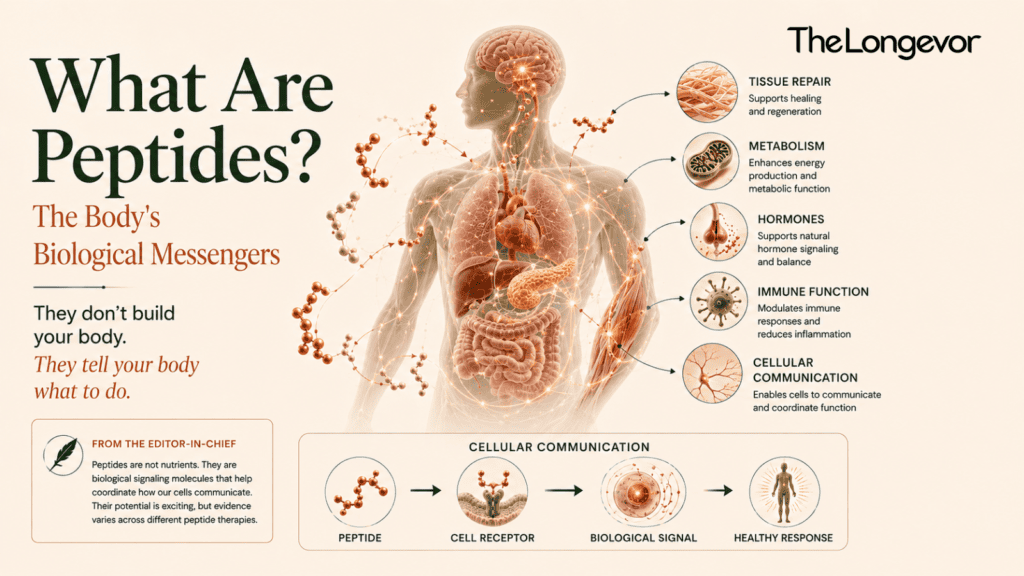
What Are Peptides? : Body’s Biological Messengers
They do not build your body. They tell your body what to do.
If you walk into any clinic that specializes in helping people live longer today you will hear one word over and over: peptides
People often talk about peptides as the big thing in staying healthy performing well in sports helping the body heal and aging in a healthy way. Even though peptides are getting more attention many people do not really understand what they are. Some people think peptides are another kind of food supplement or a smaller version of protein. Peptides are actually very different from those things.
Of giving your body nutrients peptides work as biological messengers. They carry instructions that help your cells talk to each other and work together to do all the things your body needs to do. This special ability has made the study of peptides one of the growing areas of research on living longer.
What Are Peptides?
Peptides are chains of amino acids. They usually have than 50 amino acids linked together. Proteins are made from the building blocks but they are much bigger and usually do different jobs in the body.
The job of peptides is different from the job of proteins.
Of being used to build things peptides work as signaling molecules. They send instructions from one cell to another helping to control important processes like:
- Fixing tissue
- Keeping muscles healthy
- Helping your body use fat
- Making hormones
- Keeping your system working
- Controlling your blood sugar
- Helping your brain work
- Helping your cells regenerate
In terms peptides are part of the way your body talks to itself.
Peptides vs. Proteins: What’s the Difference?
Even though peptides and proteins are both made from acids they do very different things.
Think of a protein you eat like a book. Before your body can use it it has to break it down into amino acids, which are then used to build muscles, enzymes, hormones and other proteins.
A peptide is like a short note with instructions.
Of giving your body raw materials it sends a specific biological message. Depending on the peptide that message might be:
- Fix damaged tissue
- Help your body use insulin better
- Help your blood vessels grow
- Reduce inflammation
- Help your body release hormones
- Help your cells fix themselves of building your body peptides help tell your body what to do.
How Do Peptides Work?
Every cell in your body has receptors on its surface. These receptors are like locks and peptides are like keys that fit into those locks.
When a peptide binds to its matching receptor it starts a signaling pathway inside the cell. That signal tells the cell to do a job like fixing tissue making hormones controlling metabolism or helping your immune system.
Because peptides interact with specific receptors they can influence specific biological processes without affecting other systems in your body.
That is why researchers often call peptides the body’s natural communication system. Of forcing your body to do something it does not normally do many peptides help or mimic signals that already exist in your body.
Why Are Peptides Important in Longevity Medicine?
Longevity medicine is about staying healthy and keeping your body working rather than just treating diseases after they happen.
Since aging affects how cells talk to each other researchers are studying whether certain peptides can help support the processes that keep you healthy as you age.
Today peptides are being studied for their roles in:
- Helping your body use insulin and stay metabolically healthy
- Fixing tissue and helping you recover
- Keeping your muscles healthy as you age
- Controlling inflammation
- Helping your brain work well
- Helping your cells stay
Some medicines that use peptides, like GLP-1 receptor agonists for diabetes and obesity have been well-studied. Others are still being tested in labs and with people.
It is essential to understand the differences between these peptides. Not all peptides have been proven to work.
Why Are Peptides Given by Injection?
One of the challenges with using peptides as medicine is bioavailability – how much of the peptide gets into your bloodstream and stays active.
When you swallow peptides, stomach acid and digestive enzymes break them down into ordinary amino acids before they can reach their target.
That is why many peptide therapies are given by injection which allows the peptide to bypass much of the digestive process and get into your bloodstream intact.
There are some exceptions. For example oral semaglutide uses a helper to improve how well it is absorbed through the stomach lining. Researchers are also working on technologies to make it easier to take peptides by mouth in the future.
The Future of Peptide Science
Peptides represent a change in modern medicine.
Of just replacing nutrients or treating symptoms peptides offer a way to influence biology through precise communication between cells.
Researchers are currently exploring therapies for use in longevity medicine, regenerative medicine, metabolic health, tissue repair, neurological disorders and preventive healthcare. While some therapies are already being used many are still being. Need more research before we can fully understand their potential.
Final Thoughts
Peptides are much more than supplements. They are signaling molecules that help cells talk to each other work together and respond to the bods changing needs.
Their ability to influence biological pathways has made them one of the most exciting areas of research on living longer. As our understanding of peptides continues to grow they may play an important role in supporting healthy aging, recovery and overall health.
For people interested in longevity medicine understanding what peptides are and how they differ from supplements is the first step toward understanding one of the fastest-moving fields in preventive and regenerative healthcare. Peptides are a part of this field and learning about them can help you make informed decisions, about your health.