
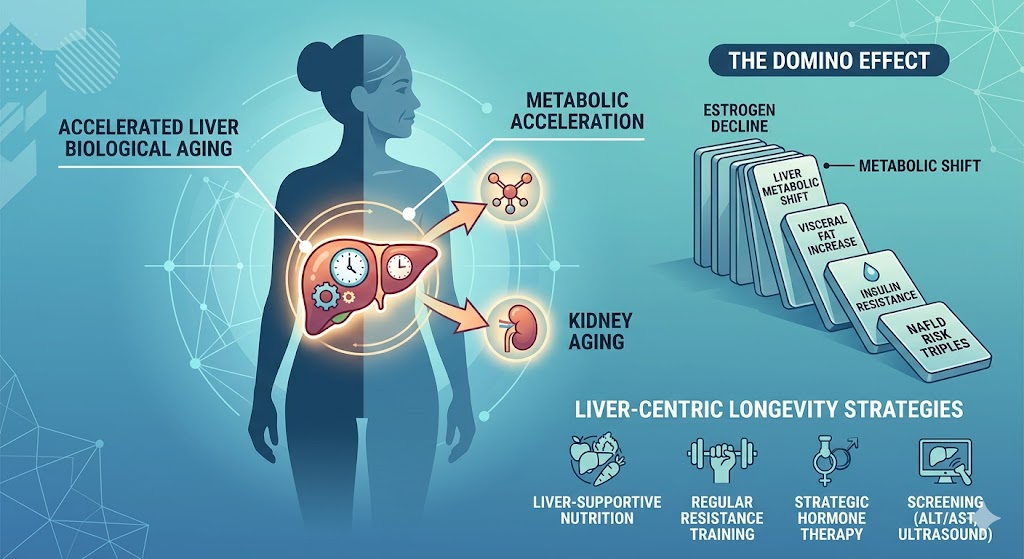
Why Menopause Is a Liver First Aging Event
For decades, menopause has been framed as a “reproductive endpoint” or a cluster of symptoms: hot flashes, mood changes, and bone loss. But mounting evidence shows it is actually a whole‑body metabolic and aging inflection point—not just for the ovaries, but for the liver, metabolic system, and kidneys.
A 2025 study in two large cohorts reveals that menopausal status, transition, and age at menopause are all linked to accelerated biological aging—with the liver clock ticking the fastest. This reframes mid‑life women’s longevity strategy from “skin‑deep aesthetics” to “liver‑centric metabolic health.”
What the study found
Researchers analyzed repeated biological age (BA) measurements in the China Multi‑ethnic Cohort (CMEC) and the UK Biobank (UKB), tracking women as they moved through pre‑, perimenopausal, and post‑menopausal stages.
Key findings:
- Compared with pre‑menopausal women, those in perimenopause or post‑menopause showed accelerated whole‑body biological aging.
- The most pronounced acceleration occurred in liver BA, followed by metabolic and kidney BA, with the liver clock leading the pack.
- Women who entered the menopausal transition between baseline and follow‑up had the steepest jump in these organ‑specific clocks, suggesting that the transition window itself is the critical period.
- Earlier age at menopause was associated with higher cumulative biological age acceleration, implying that women with early menopause experience a longer exposure to this accelerated aging trajectory.
In simple terms: menopause is not a single event; it’s a metabolic switch that revs up the liver‑first aging engine.
Why the liver, not the heart or bones?
Most people first think of osteoporosis or cardiovascular risk when they hear “menopause and aging.” But the liver is the hidden star of this story.
- The liver is the central processor of metabolism: it manages glucose, lipids, hormones, and detoxification.
- Estrogen normally supports hepatic blood flow, mitochondrial function, and antioxidant defenses. When estrogen drops, the liver bears the brunt of increased visceral fat, insulin resistance, and oxidative stress.
- This perfectly explains why non‑alcoholic fatty liver disease (NAFLD) risk triples in women after menopause and why NAFLD prevalence is already high in women with PCOS—another estrogen‑insulin‑androgen triad.
So menopause–liver aging is not incidental: it’s a hormonal‑metabolic domino effect hitting the organ that already bears the weight of metabolic imbalance.
What this means for longevity protocols
If menopause is a liver‑first aging event, then longevity strategies for mid‑life women must be liver‑centric and metabolically intelligent—not just about hot‑flash relief or “hormone replacement for symptoms.”
Here’s what to prioritize in perimenopause and early post‑menopause:
- Liver‑supportive nutrition
- Low‑refined‑carb, high‑fiber, polyphenol‑rich patterns (Mediterranean‑style, phytochemical‑dense plants).
- Strict limit on fructose‑sweetened foods and ultra‑processed fats, which drive de novo lipogenesis and steatosis.
- Metabolic health levers
- Regular resistance training and HIIT to improve insulin sensitivity and reduce visceral fat.
- Circadian‑aligned eating and sleep hygiene to protect hepatic mitochondrial function and reduce nocturnal inflammation.
- Strategic hormone therapy (when appropriate)
- Evidence suggests that early‑window hormone therapy can modestly slow biological aging and improve mid‑life health, partly by buffering metabolic and inflammatory stress on organs like the liver.
- This is not “anti‑aging glamour”; it’s organ‑system protection in a high‑risk window.
- Screening and early detection
- Measure liver enzymes (ALT/AST), waist circumference, and metabolic markers in all women with PCOS or menopausal symptoms.
- Consider ultrasound or transient elastography (FibroScan) in high‑risk subgroups to catch NAFLD before it becomes fibrosis.
For too long, menopause longevity talk has been about symptom control and bone‑heart risk. But this new cohort‑based data flips the script: the liver is the front‑line organ of menopausal aging.
If you’re designing protocols for women in their 40s–50s, your mantra should be:
“Liver first, then everything else.”
Because when you protect the liver during the menopausal transition, you’re not just slowing fatty‑liver formation—you’re slowing the whole‑system aging engine that will shape the next 20–30 years of healthspan.