
The Survival Strategy You Never Knew Your Cells Had
For decades, we’ve been taught that the internal layout of a cell is relatively fixed. Mitochondria are the powerhouses, lysosomes are the recycling centers, and the endoplasmic reticulum is the factory. But biology is rarely that static.
In a groundbreaking discovery recently highlighted in Nature, researchers have revealed that when cells are under extreme stress, mitochondria don’t just shut down – they innovate. They actually spawn entirely new, temporary organelles to ensure the cell’s survival.
The Discovery: Mitochondria-Derived Compartments (MDCs)
When a cell experiences metabolic stress – such as a sudden nutrient shortage or a spike in heat – its mitochondria begin to struggle. Usually, we think of this leading to mitophagy, where the cell simply eats its damaged mitochondria to clear the debris.
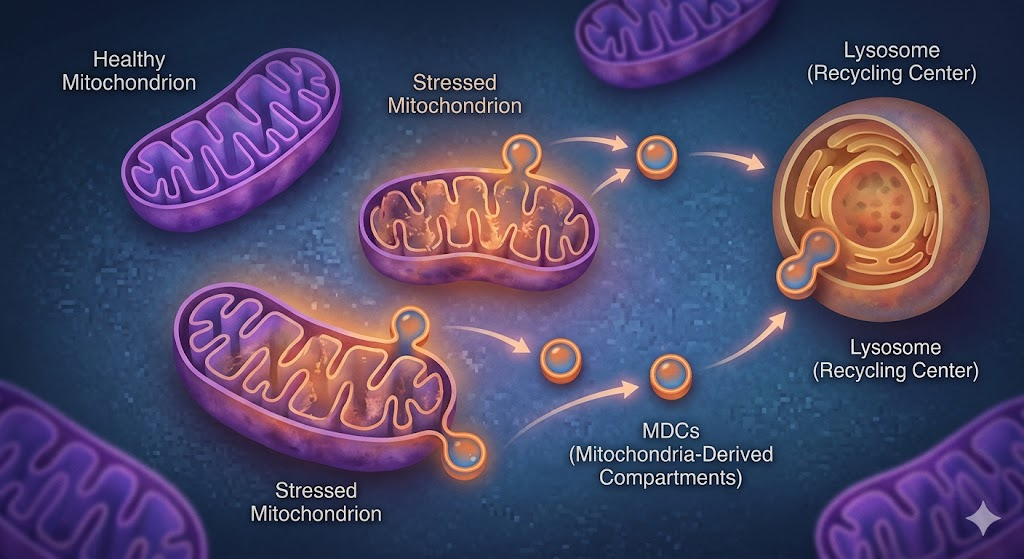
However, researchers observed a different phenomenon: Mitochondria-Derived Compartments (MDCs). Instead of the whole organelle being destroyed, the mitochondria “shed” specific proteins and lipids into a brand-new structure.
Why Does This Happen?
Think of a ship taking on water during a storm. To keep from sinking, the crew might throw heavy, non-essential cargo overboard.
MDCs function in a similar way. When the mitochondria are stressed, they become overwhelmed by certain proteins and metabolic byproducts that can become toxic if left to accumulate. By “budding off” these new compartments, the mitochondria can:
- Selectively Export Cargo: They pack up the problematic proteins and lipids that are clogging the system.
- Protect the Core: By shedding these elements into MDCs, the main body of the mitochondrion remains functional enough to keep producing energy.
- Facilitate Recycling: Once the MDC is formed, it is transported to a vacuole or lysosome to be broken down, effectively “taking out the trash” without destroying the entire powerhouse.
Why This Matters for Human Health
This isn’t just a fascinating quirk of cell biology; it has massive implications for how we understand disease and aging.
Many neurodegenerative diseases, such as Parkinson’s and Alzheimer’s, are characterized by mitochondrial dysfunction and the buildup of protein clumps. If we can figure out how to turn on or optimize the formation of MDCs, we might be able to help cells clear out toxic proteins more efficiently, potentially slowing the progression of these diseases.
Furthermore, this discovery challenges our fundamental understanding of organelle identity. It shows that the boundaries between different parts of the cell are fluid and that organelles can create new structures on the fly to adapt to a changing environment.
The Bottom Line
Our cells are far more resilient and creative than we once thought. The discovery that stressed mitochondria can literally reinvent their own structure to survive adds a new layer to our understanding of cellular health. As research continues, the humble MDC might just become a key target for the next generation of life-extending therapies.