
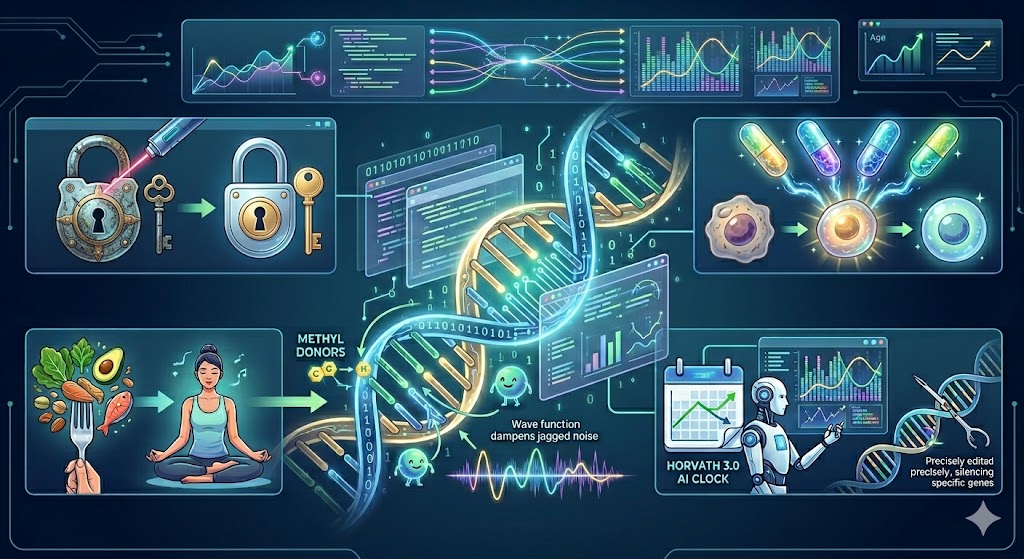
The Software Update: How to Reprogram Your Epigenetic Clock
For decades, we believed that our genes were a fixed script. You were born with a certain set of instructions, and as you aged, those instructions simply wore out. But the breakthrough of the mid-2020s has proven otherwise: Your DNA is the hardware, but your Epigenetics is the software.
Aging isn’t the hardware breaking; it’s the software getting glitchy. The good news? Software can be updated.
The Information Theory of Aging
Think of your cells as a high-definition movie on a DVD. As time passes, the disc gets scratched. The player (your cell) can no longer read the data correctly. A skin cell forgets it’s a skin cell and starts acting like a confused, aged version of itself.
This loss of information is what we call the Epigenetic Clock. By measuring the chemical tags (methyl groups) on your DNA, scientists can now predict your true biological age with 99% accuracy.
The Yamanaka Factors: The Reset Button
In 2006, Dr. Shinya Yamanaka discovered four specific genes (the Yamanaka Factors) that could turn an adult cell back into a stem cell. In 2026, we are using Partial Reprogramming.
Instead of turning a cell all the way back to a stem cell (which would be dangerous), we pulse these factors to reset the cell’s age without losing its identity. It’s like cleaning the scratches off the DVD so the movie plays perfectly again.
How You Program Your Software Daily
While clinical genetic editing is the future, you are performing epigenetic editing every time you eat, sleep, or breathe. This is called Environmental Epigenetics.
- Methyl Donors: Nutrients like B12, Folate, and Betaine act as the ‘ink’ your body uses to tag DNA. Without them, your software can’t update.
- The Sirtuin Signal: We’ve discussed Sirtuins before, but their primary role is epigenetic maintenance. They are the IT department that fixes the glitches in your DNA script.
- Stress Silencing: Chronic stress adds noise to your genetic expression. Meditation and deep sleep act as noise-canceling headphones for your genome, allowing the healthy genes to be heard.
The Evidence: The 2026 Genomic Revolution
We are currently living through the most significant shift in human history. The studies supporting ‘The Software Update’ includes:
- The T.R.I.M. Trial Success: Follow-up data from the 2025 TRIUMPH Extension showed that a combination of growth hormone, DHEA, and Metformin could reverse the epigenetic clock by an average of 2.5 years in just 12 months.
- CRISPR-Cas9 Longevity: In early 2026, the first successful gene-silencing for the PCSK9 gene (which controls cholesterol) was approved, effectively editing out the primary cause of heart disease for those at high risk (New England Journal of Medicine, 2026).
- AI-Driven Methylation Clocks: New 2026 software (Horvath 3.0) now uses deep learning to suggest specific lifestyle changes based on which of your genes are being silenced by aging, allowing for a truly personalized longevity protocol.
You are not a victim of your biology. You are the lead programmer of your own life. Every choice you make today is a line of code in the software that determines how you will feel tomorrow.