
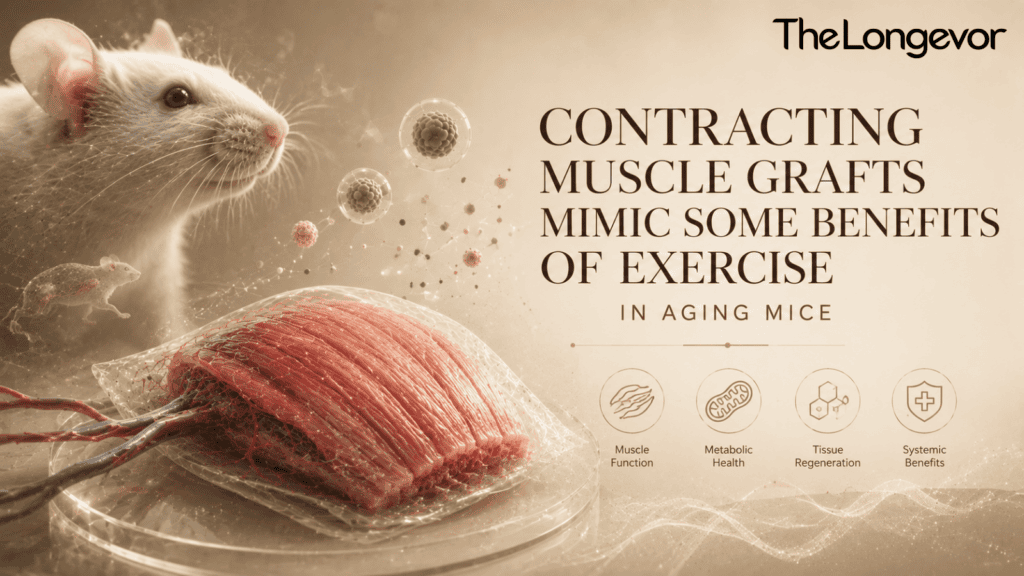
Contracting Muscle Grafts Mimic Some Benefits of Exercise in Aging Mice
Scientists have developed self-contracting muscle grafts that improve muscle function, metabolism and tissue regeneration in aged and obese mice raising new possibilities for treating conditions in which exercise is difficult or impossible.
Exercise is one of the most powerful tools we have for maintaining health as we age.
It helps preserve muscle mass, improves metabolic health, supports bone and tissue function and influences biological processes throughout the body.
But what happens when exercise is no longer possible?
A new study published in Nature Aging offers an unusual answer: what if contracting muscle itself could become a therapeutic intervention?
Researchers led by Xupeng Liu and colleagues developed a technique to transplant differentiated muscle cells beneath the skin, where they formed mature, vascularized muscle tissue that contracted continuously on its own in mice.
The resulting tissue, called a myograft, produced effects that extended well beyond the graft itself.
Turning Muscle Into a Therapeutic Organ
Skeletal muscle is usually thought of as the tissue that allows us to move.
But muscle is also a major regulator of whole-body physiology.
When skeletal muscle contracts, it releases signaling molecules and changes metabolic activity in ways that communicate with other organs. This muscle organ communication is one reason exercise can affect tissues far beyond the muscles being trained.
The researchers wanted to explore whether some of these systemic effects could be generated by contracting muscle tissue itself, without requiring the entire animal to perform conventional exercise.
To test the idea, they transplanted differentiated autologous myocytes into the subcutaneous space of mice.
The cells formed organized, vascularized muscle tissue that was capable of continuous spontaneous contraction.
In other words, the researchers created a functioning piece of muscle outside its normal anatomical location that continued to behave like muscle.
The Effects Went Beyond the Graft
The striking finding was that the effects were not limited to the transplanted tissue.
In aging mouse models, myografts were associated with improvements in whole-body muscle mass and function, metabolic regulation and tissue regeneration.
The researchers also reported effects involving several systems affected by aging, including muscle, immune, liver and adipose tissue.
In obese mice, the grafts helped counter muscle and metabolic dysfunction.
The study therefore suggests that the contracting tissue was not simply adding a small amount of muscle to the animal.
It was influencing the physiology of the organism as a whole.
Why Does Contracting Muscle Matter?
The key concept is muscle–organ communication.
Muscle is increasingly understood as a secretory and endocrine organ. During contraction, it can release signaling molecules known broadly as myokines, alongside changes in metabolites and other biological signals.
These signals can influence:
- glucose metabolism
- lipid metabolism
- inflammation
- muscle maintenance
- tissue regeneration
- bone biology
- immune function
- energy metabolism
Exercise therefore isn’t simply a mechanical process of moving the body.
It is also a biochemical conversation between contracting muscle and the rest of the organism.
The myograft experiment provides an intriguing way to study that conversation.
Rather than asking the whole body to exercise, researchers can introduce a functioning source of continuously contracting muscle and observe what happens elsewhere.
More Than an Exercise Mimic
Calling the approach an “exercise replacement” would be premature.
The researchers are doing something potentially more interesting.
The myografts could become a biological platform for treating diseases of aging.
The study showed that the transplanted muscle could also be engineered to produce therapeutic proteins. The researchers demonstrated delivery of proteins including parathyroid hormone and growth hormone, suggesting that muscle grafts could potentially function as long-term biological factories for therapeutic molecules.
That opens a second avenue beyond exercise mimicry.
Instead of repeatedly administering a drug or protein, engineered muscle tissue could potentially be designed to produce a therapeutic molecule continuously inside the body.
This moves the concept toward the intersection of regenerative medicine, cell therapy and gene therapy.
Could This Help Frailty and Age-Related Muscle Loss?
The potential longevity relevance is clear.
One of the major challenges of aging is the progressive loss of skeletal muscle mass and function, particularly in conditions such as sarcopenia and frailty.
Once physical capacity declines substantially, a difficult cycle can emerge:
Less movement → less muscle → lower strength → less activity → further loss of function.
Exercise and resistance training remain fundamental interventions, but they are not equally accessible to everyone.
Older adults with severe frailty, prolonged immobilization, injury or certain diseases may not be able to generate enough physical activity to obtain the full benefits of exercise.
The authors therefore propose myografts as a potential future strategy for diseases associated with aging where conventional exercise may be contraindicated, inaccessible or insufficient.
But There Is a Long Road to Humans
The findings are exciting—but they are mouse findings, not a human treatment.
Several major questions must be answered before this approach could become clinically relevant.
How much muscle would be required?
A small graft may be sufficient to produce measurable effects in mice, but humans are vastly larger organisms.
Researchers will need to determine whether enough tissue can be safely transplanted to generate meaningful systemic effects.
How can continuous contraction be controlled?
The ability of the graft to contract continuously is central to the study.
But for a human therapy, researchers would need to understand how contraction is regulated, how much activity is optimal and whether long-term contraction could create unwanted effects.
How safe is long-term implantation?
The grafts must remain vascularized and functional while avoiding complications associated with transplantation, immune responses, abnormal tissue growth or uncontrolled protein production.
Which signals are actually responsible?
Exercise produces an extraordinarily complex biological response.
The myograft may reproduce only a fraction of it.
Understanding exactly which molecules, pathways and tissue interactions drive the observed benefits could ultimately be more important than the graft itself.
Those discoveries could lead to simpler therapies that reproduce specific muscle-derived signals without requiring an implant.
The Future May Not Be About Replacing Exercise
The most important takeaway is not that scientists have found a way to eliminate exercise.
They have not.
For healthy people, exercise remains one of the most comprehensive interventions for maintaining physical and metabolic health.
Instead, this research reveals something deeper about why muscle matters.
If a relatively small amount of continuously contracting muscle can influence muscle function, metabolism, regeneration and other aging-associated processes throughout the body, then skeletal muscle may be more powerful as a therapeutic organ than previously appreciated.
The long-term vision could involve engineered muscle serving as:
A source of exercise-associated signals.
A regenerative tissue.
A biological factory for therapeutic proteins.
Or potentially a combination of all three.
The study also illustrates a broader shift taking place in longevity science.
Rather than simply trying to slow aging with a single molecule, researchers are increasingly exploring ways to engineer biological systems themselves.
In this case, the system is muscle.
And the question is no longer simply:
“How much exercise do we need to stay healthy?”
It may eventually become:
“Which signals generated by exercise actually make us healthier—and can biology deliver them when movement is no longer possible?”
For now, the answer remains experimental.
But the idea that a living piece of contracting muscle could influence the health of an entire organism represents a fascinating new direction in regenerative medicine and healthspan research.