
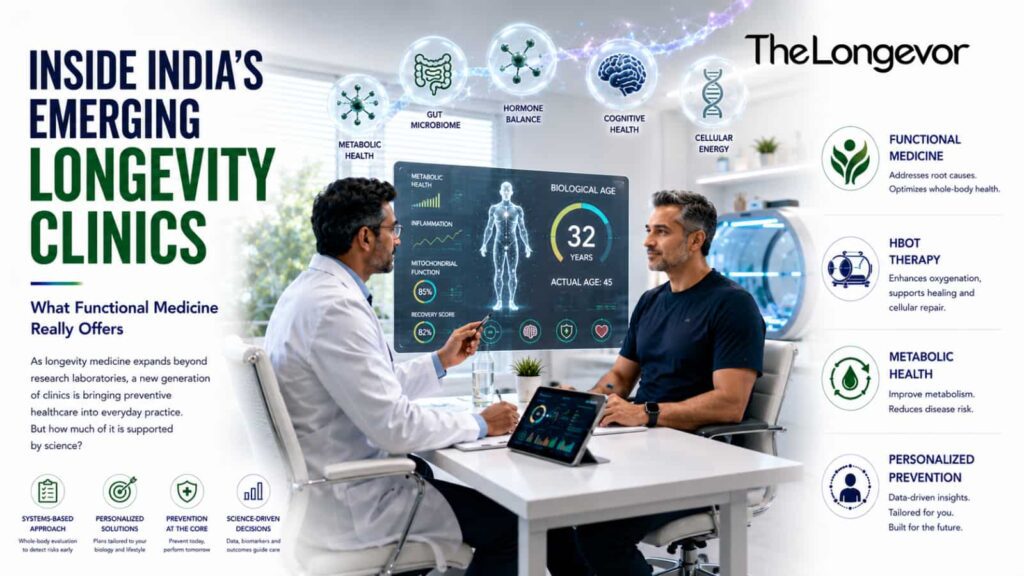
How India’s Longevity Clinics Use Functional Medicine
If you walked into a longevity clinic today, what would actually happen? Would you undergo cutting-edge medical assessments designed to identify early signs of biological aging? Or would you encounter therapies whose scientific evidence is still evolving?
These questions are becoming increasingly relevant as longevity medicine begins moving from research institutions into clinical practice. Around the world, clinics focused on healthy aging are offering services that combine preventive medicine, nutrition, metabolic health, advanced diagnostics, and emerging therapeutic technologies.
India is now beginning to see the same trend. One example is CureFit Clinic in Chandigarh, which offers therapies commonly associated with functional medicine and longevity care, including Hyperbaric Oxygen Therapy (HBOT), metabolic health programs, microbiome assessments, hormone optimization, peptide therapy, and personalized preventive care.
Rather than evaluating one clinic, this article explores a broader question: What exactly do longevity clinics offer, and where does the science currently stand?
Why Longevity Clinics Are Emerging
For decades, modern medicine has been extraordinarily successful at diagnosing disease and treating it once it appears.
Longevity medicine asks a different question. Can we maintain health before disease develops? Instead of focusing on a single organ or condition, longevity medicine examines how multiple biological systems change with age.
These include:
- Metabolic health
- Immune function
- Hormonal regulation
- Muscle mass
- Nutrition
- Sleep
- Cardiovascular health
- Cognitive performance
- Biological aging biomarkers
Rather than treating diabetes, heart disease, or osteoporosis separately, the goal is to understand the underlying biological processes that increase the risk of developing them. This systems-based philosophy has become one of the defining characteristics of modern longevity medicine.
What Happens During a Longevity Consultation?
Unlike a routine medical appointment focused on a specific symptom, longevity consultations are often far more comprehensive. A typical assessment may include:
- Detailed medical and family history
- Nutrition and lifestyle assessment
- Body composition analysis
- Metabolic health evaluation
- Blood biomarkers
- Sleep assessment
- Physical activity review
- Hormonal evaluation (where clinically appropriate)
The objective is not simply to identify disease but to understand how different physiological systems are functioning together. This reflects a broader shift toward personalized preventive healthcare.
Functional Medicine: Looking Beyond Symptoms
Many longevity clinics are influenced by the principles of functional medicine. Rather than asking, “Which medication treats this disease?” functional medicine often begins with another question: “Why did this problem develop in the first place?”
Practitioners examine interactions between nutrition, metabolism, inflammation, hormones, gut health, physical activity, sleep, and environmental factors. The philosophy recognizes that chronic diseases rarely emerge from a single cause.
Instead, they often develop gradually through multiple interconnected biological processes. This systems-based approach aligns closely with many areas of longevity research.
Hyperbaric Oxygen Therapy (HBOT)
One of the most recognizable therapies offered by longevity clinics is Hyperbaric Oxygen Therapy, or HBOT. During treatment, individuals breathe nearly pure oxygen inside a pressurized chamber.
The increased pressure allows significantly more oxygen to dissolve into the bloodstream than under normal atmospheric conditions. HBOT is already an established medical treatment for conditions including:
- Decompression sickness
- Carbon monoxide poisoning
- Radiation tissue injury
- Certain chronic non-healing wounds
Researchers are now exploring whether repeated HBOT sessions may also influence biological processes relevant to healthy aging. Early studies have investigated its effects on tissue repair, vascular health, inflammation, cognitive function, and biological aging markers.
Some findings appear promising. However, many longevity-related applications remain under investigation, and current evidence is not yet sufficient for routine clinical recommendations.
Metabolic Health: One of the Strongest Foundations of Healthy Aging
Among the many services offered by longevity clinics, metabolic health is supported by some of the strongest scientific evidence. Poor metabolic health contributes to:
- Type 2 diabetes
- Cardiovascular disease
- Fatty liver disease
- Obesity
- Chronic inflammation
Clinics frequently assess body composition, insulin sensitivity, blood glucose regulation, lipid profiles, and lifestyle factors before recommending personalized interventions.
Unlike many emerging longevity therapies, improving metabolic health already has substantial evidence supporting its ability to reduce long-term disease risk.
The Growing Interest in the Gut Microbiome
Another rapidly expanding area is microbiome medicine. The human digestive tract contains trillions of microorganisms that influence digestion, immune regulation, inflammation, metabolism, and even communication between the gut and the brain. Researchers are still determining precisely how these microbial communities influence aging.
Nevertheless, maintaining a diverse and resilient microbiome is increasingly viewed as an important component of long-term health. For this reason, many longevity clinics include dietary counseling, fiber optimization, and microbiome-focused nutrition within personalized treatment plans.
Hormones and Healthy Aging
Hormones regulate nearly every aspect of human physiology. They influence:
- Muscle maintenance
- Bone health
- Sleep
- Mood
- Energy metabolism
- Reproductive health
As people age, hormone levels naturally change. This has contributed to growing interest in hormone optimization. However, hormone replacement is not appropriate for everyone. Clinical decisions should always be guided by careful medical evaluation, laboratory testing, symptoms, and established clinical guidelines rather than age alone.
Emerging Therapies: Separating Promise from Proof
Longevity clinics increasingly offer therapies that have attracted considerable public attention. These include:
- Peptide therapy
- IV nutrient therapy
- Infrared therapy
- Ozone therapy
Importantly, these interventions do not all share the same scientific foundation. Peptide research is expanding rapidly, with scientists investigating applications in tissue repair, metabolism, immune regulation, and muscle function.
IV nutrient therapy may provide clinical benefit in individuals with documented deficiencies but remains controversial as a routine intervention for healthy adults. Infrared therapy continues to be studied for recovery and circulation, while ozone therapy remains one of the more debated areas because high-quality clinical evidence remains limited.
Understanding these differences is essential. Scientific plausibility does not necessarily translate into proven clinical benefit.
Questions Every Patient Should Ask
As longevity medicine continues to evolve, informed decision-making becomes increasingly important. Before pursuing any therapy, patients should consider asking:
- What evidence supports this intervention?
- Has it been studied in humans?
- Is the treatment approved for this indication?
- What benefits are realistically expected?
- What are the potential risks?
- How will progress be measured?
- Are biomarkers being monitored?
The quality of the questions often determines the quality of the healthcare decisions that follow.
Why These Clinics Matter
Whether every therapy currently offered ultimately becomes standard medical practice remains uncertain. What is clear, however, is that longevity clinics reflect a broader transformation in healthcare.
Rather than waiting for disease to appear, clinicians are increasingly attempting to preserve physiological resilience before significant decline occurs. This shift mirrors developments occurring throughout gero science itself.
Researchers are moving beyond treating individual diseases toward understanding—and potentially modifying—the biological processes that increase disease risk across the lifespan. Clinics dedicated to preventive and personalized medicine represent one of the earliest attempts to translate this research into real-world healthcare.
Conclusion
The emergence of longevity clinics in India reflects a growing interest in preventive, personalized healthcare. Therapies such as Hyperbaric Oxygen Therapy, metabolic health programs, microbiome-focused care, hormone optimization, and peptide research illustrate how medicine is gradually expanding beyond disease treatment toward preserving long-term health and function.
Not every intervention currently offered has reached the same level of scientific validation.
Some are supported by decades of clinical evidence, while others remain promising but experimental. For patients, the most valuable approach is neither blind enthusiasm nor blanket skepticism, but informed, evidence-based decision-making.
As longevity science continues to mature, clinics like these may become increasingly common—not because they promise immortality, but because they reflect a changing philosophy of healthcare: one that seeks not only to help people live longer, but to help them live better.