
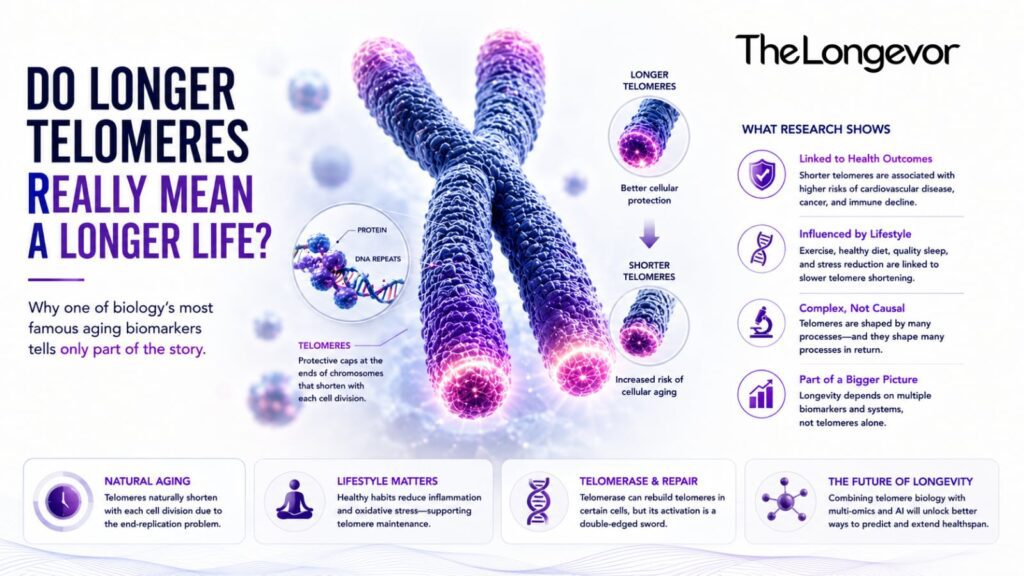
Do Longer Telomeres Really Mean a Longer Life?
Why one of biology’s most famous aging biomarkers tells only part of the story. For decades, telomeres have captured the imagination of scientists, entrepreneurs, and biohackers alike. Often described as the protective caps at the ends of chromosomes, they have become one of the most recognizable symbols of biological aging. Countless supplements, wellness programs, and anti-aging clinics promise to “protect your telomeres” or even “lengthen” them in pursuit of a longer, healthier life.
But how much of that promise is supported by science? The relationship between telomeres and aging is far more nuanced than popular headlines suggest. While telomere shortening is undeniably linked to aging and disease, researchers increasingly recognize that telomeres are only one piece of a much larger biological puzzle.
So, can measuring—or even extending—telomeres really slow aging? Or have they become one of longevity science’s most misunderstood biomarkers?
What Are Telomeres?
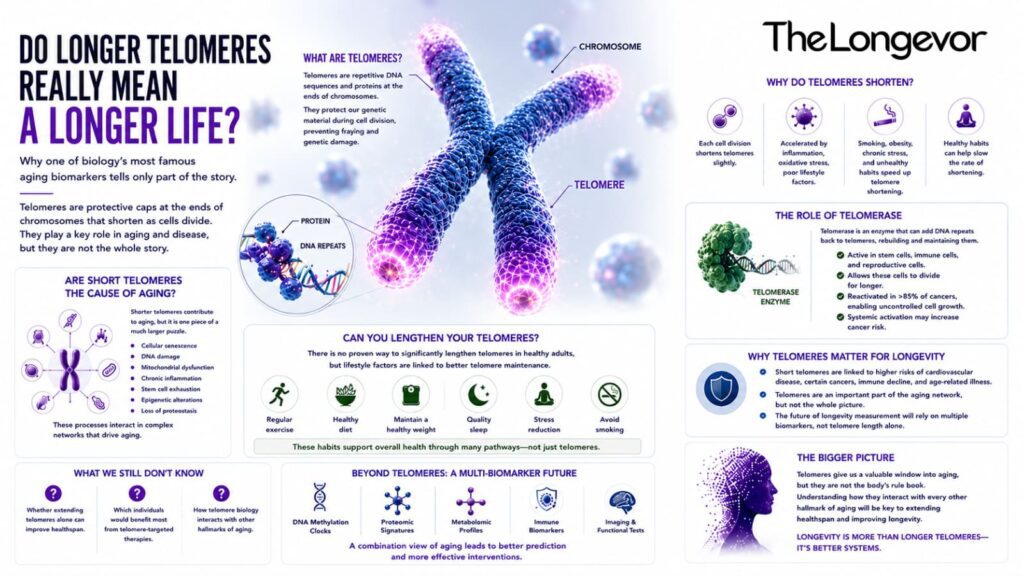
Every human cell contains 46 chromosomes that carry our genetic blueprint. At the ends of each chromosome are telomeres—repetitive DNA sequences bound to specialized proteins that protect chromosomes during cell division. They function much like the plastic tips at the ends of shoelaces, preventing chromosomes from fraying, sticking together, or losing important genetic information.
Each time a cell divides, a small portion of these protective caps is lost. Eventually, telomeres become so short that cells can no longer divide safely. Instead, they enter cellular senescence or undergo programmed cell death (apoptosis). This process acts as an important tumor-suppressing mechanism by preventing damaged cells from replicating indefinitely.
Why Do Telomeres Shorten?
Telomere shortening is a natural consequence of aging. Every round of DNA replication leaves chromosomes slightly shorter because DNA polymerase cannot fully copy the ends of linear DNA—a phenomenon known as the end-replication problem.
However, chronological aging is only part of the story. Research suggests telomeres may shorten more rapidly under conditions such as:
- Chronic inflammation
- Oxidative stress
- Smoking
- Obesity
- Poor metabolic health
- Chronic psychological stress
- Physical inactivity
Conversely, healthier lifestyles have been associated with slower rates of telomere shortening, although these relationships are complex and do not necessarily imply causation.
The Science Behind Telomerase
Nature has evolved a partial solution. Certain cells—including stem cells, reproductive cells, and many immune cells—produce an enzyme called telomerase. Telomerase can rebuild portions of telomeres by adding DNA repeats back onto chromosome ends, allowing these cells to divide for much longer than ordinary body cells.
Unfortunately, most adult somatic cells express very little telomerase. This limitation is thought to balance two competing priorities:
- Preserving tissue regeneration
- Preventing uncontrolled cell growth
Interestingly, more than 85% of human cancers reactivate telomerase, enabling tumor cells to divide almost indefinitely. This explains why artificially increasing telomerase throughout the body is not viewed as a straightforward anti-aging strategy.
Are Short Telomeres the Cause of Aging?
One of the biggest misconceptions in longevity science is that telomere shortening causes aging by itself. The reality is more complicated. Telomere dysfunction contributes to aging, but aging also involves numerous interconnected biological processes, including:
- Cellular senescence
- DNA damage
- Mitochondrial dysfunction
- Chronic inflammation
- Stem-cell exhaustion
- Epigenetic alterations
- Loss of proteostasis
Rather than acting independently, these hallmarks influence one another throughout life. Short telomeres may accelerate some aging processes while also being shaped by them. Many geroscientists now view telomeres as one component of an interconnected aging network rather than a standalone biological clock.
Can You Lengthen Your Telomeres?
The internet is full of products claiming to extend telomeres. The evidence is considerably less dramatic. Lifestyle factors consistently associated with healthier aging also appear to support telomere maintenance:
- Regular physical activity
- Mediterranean-style dietary patterns
- Healthy body weight
- Quality sleep
- Stress reduction
- Avoiding smoking
These interventions improve overall health through many biological pathways, not simply by influencing telomeres. Whether any intervention can meaningfully increase telomere length in healthy adults—and whether doing so would improve lifespan—remains uncertain.
Why Telomeres Matter for Longevity
Although telomeres are not a complete measure of aging, they remain biologically important. Short telomeres have been associated with increased risks of cardiovascular disease, certain cancers, immune dysfunction, and age-related decline.
Researchers continue exploring whether telomere biology could contribute to future therapies for regenerative medicine, healthy aging, and age-related diseases. At the same time, many scientists now believe the future of longevity measurement will rely on multiple biomarkers rather than telomere length alone.
DNA methylation clocks, proteomic signatures, metabolomic profiles, immune biomarkers, and imaging-based assessments may ultimately provide a more comprehensive picture of biological age.
What We Still Don’t Know
Despite decades of research, important questions remain. Scientists still do not know:
- Whether extending telomeres alone can improve healthspan.
- Which individuals would benefit most from telomere-targeted therapies.
- How telomere biology interacts with other hallmarks of aging.
- Whether telomerase activation can be used safely without increasing cancer risk.
- How telomere length should be interpreted alongside modern biological age clocks.
Future studies will likely focus less on telomere length itself and more on how telomeres integrate into the broader biology of aging.
Conclusion
Telomeres remain one of the most recognizable features of aging biology—and for good reason. They protect our chromosomes, influence cellular lifespan, and play an important role in maintaining tissue health. Yet they are not the body’s sole aging clock.
Modern longevity science increasingly views aging as a network of interconnected biological processes rather than a single mechanism. Telomeres provide one valuable window into that network, but understanding—and eventually modifying—aging will require looking beyond chromosome ends to the broader systems that shape human health over time.
The future of longevity medicine may not depend on making telomeres longer. It may depend on understanding how they interact with every other hallmark of aging.
Telomeres are protective DNA-protein structures at the ends of chromosomes that help preserve genetic stability during cell division.
Yes. Telomeres naturally shorten as cells divide, although the rate of shortening can be influenced by genetics, lifestyle, and environmental factors.
Some cells naturally use the enzyme telomerase to maintain telomeres. While healthy lifestyle habits may support telomere maintenance, there is currently no clinically proven therapy that safely lengthens telomeres to extend lifespan in healthy people.
Not necessarily. Researchers increasingly use multiple biomarkers—including DNA methylation clocks, proteomic signatures, and immune biomarkers—because aging involves many interconnected biological processes rather than a single mechanism.