
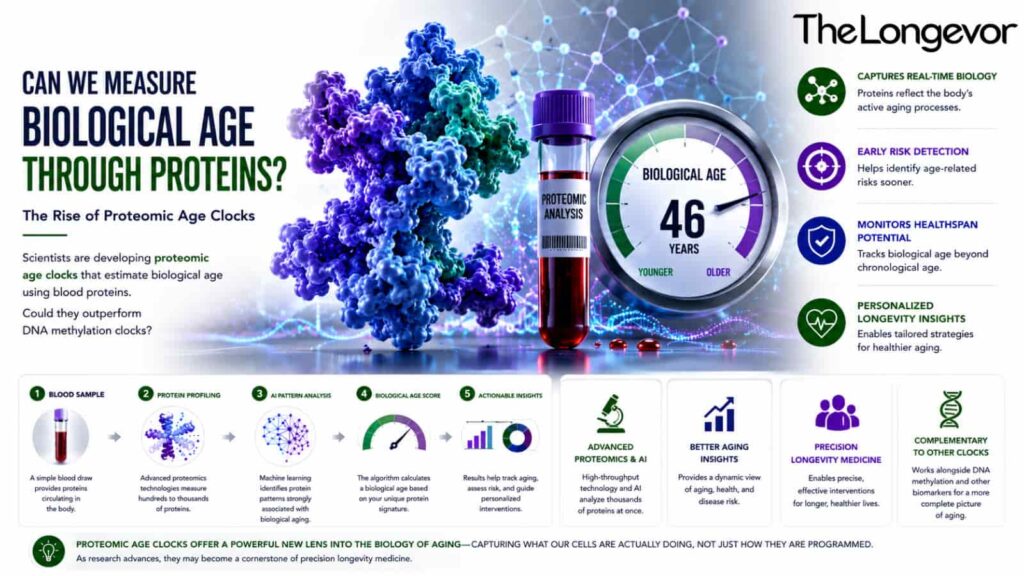
Can We Measure Biological Age Through Proteins? The Rise of Proteomic Age Clocks
For centuries, age has been measured with a calendar. You are born on a certain day, and every year that passes adds another number. But biology doesn’t always follow the calendar.
Some people remain remarkably healthy well into their eighties, while others develop heart disease, diabetes, or cognitive decline decades earlier. Chronological age tells us how long we’ve lived. It says very little about how well our bodies have aged.
This distinction has become one of the biggest questions in longevity science.
Researchers have spent years developing tools that estimate biological age—a measure of how “old” the body’s tissues and organs appear at the molecular level. DNA methylation clocks have dominated this field, but scientists are now exploring another powerful approach: proteomic age clocks.
A new study published in Nature Aging brings this technology into sharper focus, suggesting that proteins circulating in our blood may provide one of the clearest windows yet into how the body ages.
If validated, proteomic clocks could help researchers evaluate anti-aging therapies faster, identify disease risk earlier, and move longevity medicine closer to routine clinical practice.
What Happened?
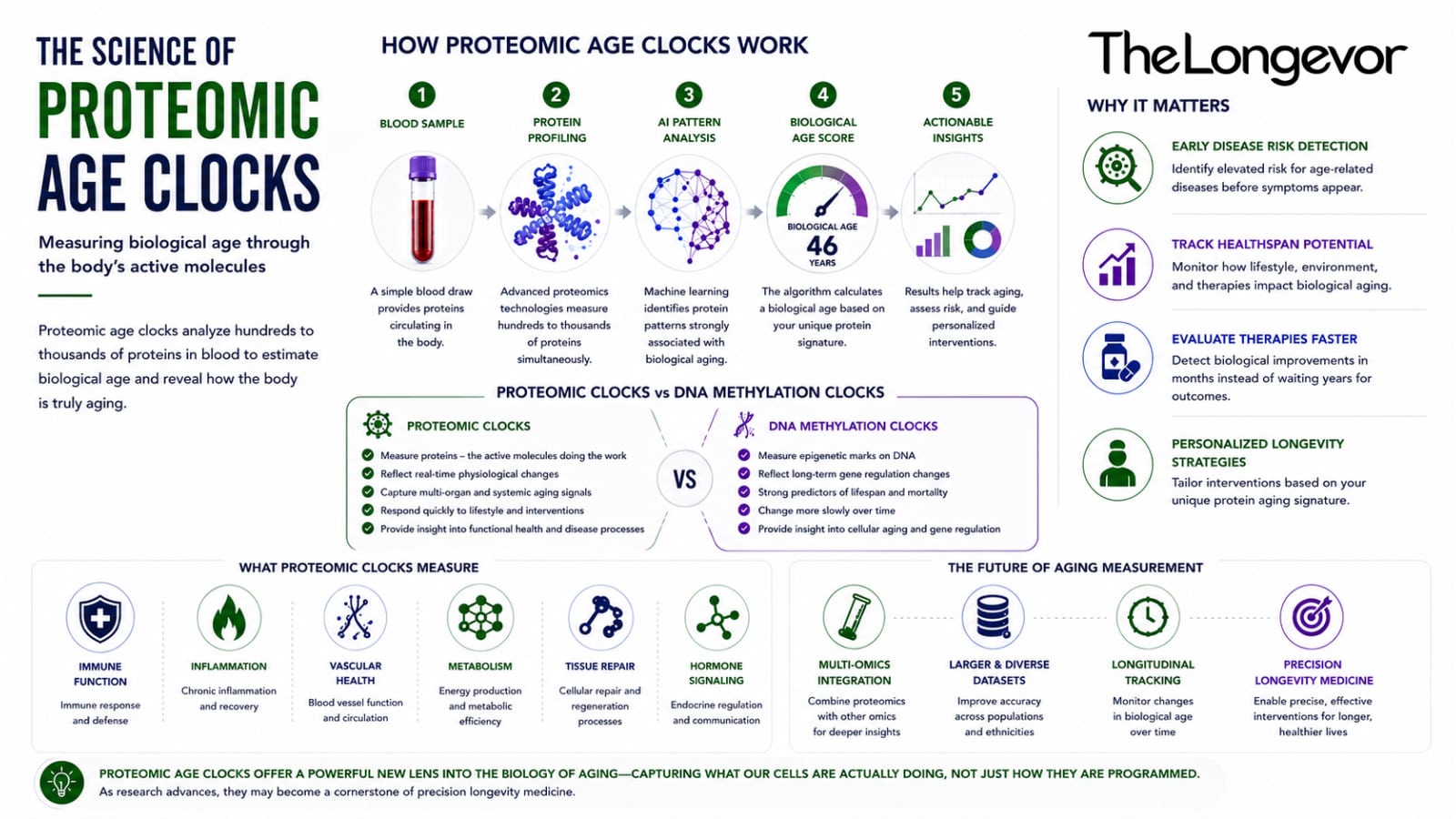
Researchers evaluated modern proteomic age clocks—algorithms that estimate biological age by measuring hundreds or even thousands of proteins in blood samples.
Unlike DNA methylation clocks, which examine chemical modifications on DNA, proteomic clocks focus on the molecules actively performing the body’s biological work.
Proteins regulate virtually every physiological process, including:
- Immune function
- Inflammation
- Cellular communication
- Metabolism
- Tissue repair
- Hormone signaling
As we age, the abundance of many proteins changes in predictable ways. Using advances in high-throughput proteomics and artificial intelligence, researchers can now analyze these changes simultaneously to estimate an individual’s biological age.
The study examined how well different proteomic clocks captured aging-related changes and how they compared with existing biological age measurements. Rather than replacing other aging biomarkers, the findings suggest that proteomic clocks may provide complementary information by capturing physiological changes occurring throughout the body.
The work represents another step toward developing reliable tools capable of measuring aging in months instead of waiting decades for disease outcomes or lifespan data.
The Science Behind It
Proteins are often called the workhorses of biology. While DNA stores genetic information, proteins carry out nearly every task inside cells.
They transport oxygen, regulate metabolism, coordinate immune responses, repair tissues, transmit signals between cells, and maintain the structure of organs. Because proteins respond continuously to both genetics and environmental influences, they provide a dynamic picture of an individual’s biological state.
This makes them attractive candidates for measuring aging.As humans grow older, the blood proteome undergoes widespread remodeling. Researchers have observed consistent age-related shifts in proteins involved in:
- Chronic inflammation
- Immune regulation
- Blood vessel function
- Extracellular matrix remodeling
- Hormone signaling
- Metabolic health
Rather than relying on a single protein, modern proteomic clocks integrate information from hundreds—or even thousands—of circulating proteins.
Machine-learning algorithms identify patterns that correlate with healthy aging, disease risk, and mortality. Importantly, these clocks may capture biological processes that differ from those reflected by DNA methylation clocks.
Epigenetic clocks estimate biological age by measuring chemical modifications that regulate gene activity. Proteomic clocks, in contrast, assess the downstream biological consequences of those genetic programs.
Think of it this way:
- DNA methylation tells us how cells may be programmed.
- Proteins reveal what those cells are actually doing.
Both perspectives are valuable. Together, they may offer a more complete understanding of aging than either can provide alone.
Why It Matters for Longevity
One of the greatest obstacles in longevity research is measurement. If researchers cannot accurately determine whether someone is aging faster—or slower—than expected, evaluating new therapies becomes extremely difficult.
This challenge affects nearly every intervention currently under investigation. Can exercise slow biological aging?
Do senolytics reduce age-related decline? Does time-restricted eating improve health span? Are peptide therapies influencing aging biology? Each of these questions ultimately depends on having reliable biomarkers.
Proteomic clocks may help solve part of that problem. Because proteins change rapidly in response to physiological conditions, they could allow scientists to detect meaningful biological improvements long before diseases appear.
They may also help identify individuals at higher risk of age-related illnesses, enabling earlier and more personalized interventions.In the future, proteomic profiling could become part of routine preventive healthcare, allowing physicians to monitor biological aging alongside cholesterol, blood glucose, and blood pressure.
That vision remains aspirational, but studies like this move the field closer to making it possible.
What We Still Don’t Know
Despite the excitement, several important questions remain. Researchers are still determining:
- Which proteins provide the most reliable indicators of biological aging.
- Whether proteomic clocks perform consistently across different ethnicities and populations.
- How lifestyle interventions influence proteomic age over time.
- Whether improvements in proteomic age translate into longer healthspan or reduced disease risk.
There is also a broader question. Can any single biomarker fully capture the complexity of aging? Many scientists increasingly believe the answer is no.
Instead, the future may involve combining multiple biological clocks—including DNA methylation, proteomics, metabolomics, immune biomarkers, and imaging—to create a more comprehensive picture of human aging.
Conclusion
For years, the search for accurate biological age measurements has centered largely on DNA. Proteomic age clocks suggest that proteins may tell an equally important part of the story.
By capturing the body’s active biological processes, these tools could provide new insights into how aging unfolds across multiple organs and systems simultaneously. Whether proteomic clocks ultimately become standard tools in longevity medicine will depend on continued validation and clinical testing.
But one thing is becoming increasingly clear. The future of healthy aging may depend not only on discovering therapies that slow aging—but also on developing better ways to measure it.
A proteomic age clock is a biological age estimator that uses patterns of proteins circulating in the blood to assess how rapidly an individual is aging.
DNA methylation clocks measure epigenetic changes that regulate gene activity, while proteomic clocks analyze proteins that reflect the body’s active physiological processes.
Possibly. If validated through large clinical studies, proteomic age measurements could eventually become part of preventive healthcare and longevity-focused medicine.