
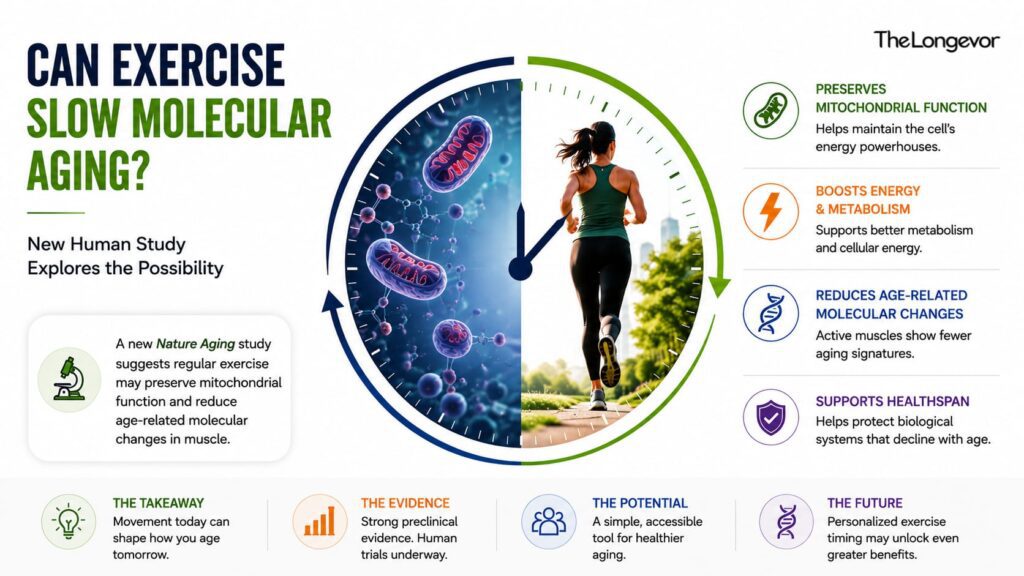
Can Exercise Slow Molecular Aging? New Human Study Explores the Possibility
We already know exercise helps us live longer. Decades of research have linked regular physical activity to lower risks of heart disease, type 2 diabetes, dementia, and premature death. But a more intriguing question has lingered beneath the surface of longevity science: could exercise actually keep our muscles biologically younger?
Until recently, that question has been difficult to answer. Scientists could observe that active people tended to age more healthily, but understanding what was happening inside their cells required far more sophisticated tools.
A new study published in Nature Aging offers one of the clearest molecular snapshots yet. Using advanced multi-omics technologies, researchers compared the skeletal muscle of physically active and sedentary adults across different age groups. Their findings suggest that lifelong exercise may preserve key biological systems that normally decline with age, from energy production to cellular metabolism.
The study doesn’t claim that exercise stops aging. Instead, it raises a fascinating possibility: perhaps one of the most powerful longevity interventions has been available all along.
What Happened?
To investigate how exercise influences aging at the molecular level, researchers analyzed skeletal muscle samples from young adults, older sedentary individuals, and older adults who had maintained long-term physical training.
Rather than relying on a single biological measurement, the team used a multi-omics approach—a combination of technologies that examines genes, proteins, metabolites, and other molecular processes simultaneously. This allowed them to build a detailed picture of how aging affects muscle and whether regular exercise changes that trajectory.
The differences were striking.
Compared with sedentary older adults, physically active participants showed roughly 50% fewer age-related molecular changes across several biological pathways. Many of the preserved pathways were linked to mitochondrial function, cellular energy production, and metabolic regulation—systems that typically decline as we grow older.
The researchers also found that trained muscles responded more robustly to exercise at the molecular level, suggesting that years of physical activity may help maintain the body’s ability to adapt to physiological stress. Rather than simply producing stronger muscles, exercise appeared to preserve some of the biological machinery that keeps those muscles functioning efficiently with age.
The Science Behind It
Why would exercise have such a profound effect on aging muscle?
The answer begins with the mitochondria—the tiny structures often called the powerhouses of the cell. Every movement we make, from climbing stairs to lifting a coffee mug, depends on these microscopic energy factories producing ATP, the molecule that powers nearly every cellular process.
As we age, however, mitochondria gradually become less efficient. Energy production declines, damaged cellular components accumulate, and muscles lose strength, endurance, and their ability to recover from stress. These changes contribute to sarcopenia, the age-related loss of muscle mass and function that affects millions of older adults worldwide.
Exercise appears to interrupt this process.
Repeated physical activity challenges muscle cells to generate more energy, repair damage, and build new mitochondria. Over time, this continual cycle of stress and adaptation may help preserve the cellular systems that normally deteriorate with age.
The new study suggests these benefits extend far beyond muscle size or fitness. Researchers observed healthier patterns of gene expression, improved metabolic pathways, and stronger mitochondrial activity in trained individuals. In other words, exercise wasn’t simply changing how muscles looked—it appeared to influence how they functioned at a molecular level.
This reinforces an emerging idea in geroscience: healthy aging may depend as much on maintaining cellular resilience as it does on preventing disease.
Why It Matters for Longevity
One of the biggest challenges in longevity research is finding interventions that influence multiple hallmarks of aging at once.
Exercise has always stood out because its effects reach nearly every organ system. It improves cardiovascular health, supports metabolic function, reduces chronic inflammation, enhances cognitive performance, and lowers the risk of numerous age-related diseases.
This study adds another layer to that picture.
If regular physical activity helps preserve the molecular architecture of aging muscle, it suggests exercise isn’t simply treating the consequences of aging—it may be influencing some of the biological processes that drive functional decline in the first place.
That doesn’t mean exercise is an anti-aging cure. Aging is extraordinarily complex, involving interactions between genetics, environment, metabolism, and lifestyle. But it does reinforce why exercise remains one of the few interventions consistently supported across epidemiology, physiology, and molecular biology.
As scientists search for drugs capable of slowing biological aging, studies like this remind us that one of the most effective strategies may already be part of everyday life.
What We Still Don’t Know
Despite its compelling findings, the study leaves several important questions unanswered.
Can starting an exercise routine later in life produce the same molecular benefits as decades of consistent training? Do resistance training, endurance exercise, and high-intensity interval training affect aging through similar mechanisms, or does each influence different biological pathways?
Researchers also don’t yet know how much exercise is needed to preserve these molecular signatures, or whether biological age measurements can eventually be used to personalize exercise prescriptions.
Perhaps the biggest question is whether these molecular changes translate into meaningful differences in healthspan—the years of life spent free from chronic disease and disability. Long-term human studies will be needed to answer that.
Conclusion
For decades, exercise has been recommended because it helps prevent disease. This study suggests its benefits may run even deeper.
By preserving mitochondrial function, metabolic health, and key molecular pathways within skeletal muscle, regular physical activity may help maintain the biological systems that gradually decline with age.
The findings don’t prove that exercise can slow human aging. But they do strengthen an idea that has become increasingly central to longevity science: the choices we make throughout life may influence our biology in ways we’re only beginning to understand.
And perhaps the most intriguing question isn’t whether exercise changes our muscles—but whether it changes how those muscles experience time itself.
IL-11 (interleukin-11) is a signaling protein involved in inflammation, tissue repair, and fibrosis. Researchers are investigating its role in several age-related diseases.
The ovaries undergo continuous hormonal and cellular changes throughout life. Declining follicle numbers, fibrosis, inflammation, and altered tissue signaling all contribute to reproductive aging.
No. The research was conducted in mice and does not demonstrate that blocking IL-11 can delay menopause in humans.
Ovarian function influences much more than fertility. Hormones produced by the ovaries affect bone health, metabolism, cardiovascular function, and cognitive health, making reproductive aging an important part of overall healthy aging.